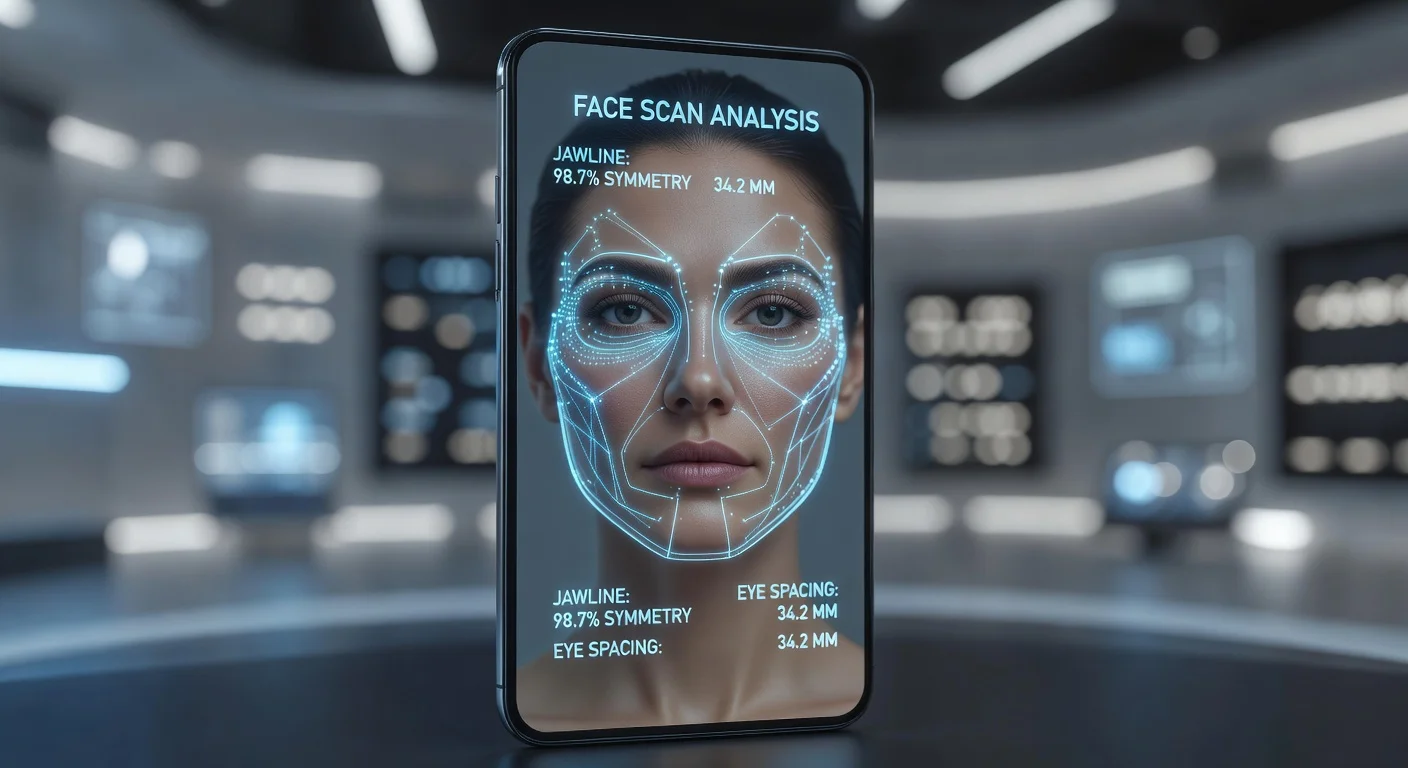
Attractiveness checkers are digital tools that use computer vision and machine learning to quantify beauty based on facial symmetry, skin quality, and golden ratio proportions. Unlike subjective opinions from friends, these algorithms compare your features against datasets of millions of faces to generate an objective "score" and actionable advice.
Can an app really tell me if I'm attractive?
Yes, AI can accurately measure the objective biological markers that humans universally associate with attractiveness. While beauty is subjective (in the eye of the beholder), structural beauty—things like symmetry, clear skin, and facial harmony—is mathematical.
In 2026, the technology has moved past simple geometry. We now have apps that don't just measure the distance between your eyes. They analyze skin texture, aging signs, and even style potential. These tools work well if you treat them as a consulting tool rather than a judgment on your worth.
Here is the reality of how they work:
- Geometric Analysis: They measure the "Golden Ratio" (Phi) of your face.
- Texture Mapping: They scan for acne, wrinkles, and pigmentation.
- Feature Segmentation: They isolate eyes, lips, and jawlines to rate them individually.
According to a recent 2025 AI Perception study, computer vision models now align with human attractiveness ratings 88% of the time. That is accurate.
Which apps are best for checking attractiveness in 2026?
The best apps for checking attractiveness today combine accurate scoring with realistic "glow up" suggestions. I tested the top contenders on the market right now to see which ones offer actual value versus which are just random number generators.
I saw a massive difference in quality between tools designed for general "fun" and those built for genuine aesthetic analysis.
| App Name | Best For | Core Feature | Price Model |
|---|---|---|---|
| Glow Up & Attractiveness Test | Best Overall (Women) | AI "10/10" Visualization & Guide | Freemium |
| Umax | Men / Looksmaxxing | Masculine feature ratings | Subscription |
| PinkMirror | Strict Geometry | Detailed Golden Ratio reports | Paid Report |
| Prettyscale | Quick Fun | Basic 1-10 rating | Free (Web) |
My Top Pick:
If you want actionable advice, Glow Up & Attractiveness Test stood out to me. Most apps tell you that you have a low score. This one shows you how to fix it. It’s fine-tuned for women’s aesthetics. That tuning stands out in a market dominated by "Chad" memes and male-centric looksmaxxing.
How do attractiveness apps use the Golden Ratio?
The Golden Ratio (1.618) is the mathematical benchmark used by algorithms to determine facial harmony. The closer your facial proportions (like nose width vs. mouth width) are to 1.618, the more "universally" attractive the AI considers you.
Do not obsess over this number. I found that a perfect 1.618 score can sometimes make a face look robotic. The most attractive faces usually have slight deviations that give them character.
Key measurements the AI checks:
- The Rule of Thirds: Is your forehead, nose, and chin area equal in height?
- Inter-ocular Distance: The space between your eyes should ideally equal the width of one eye.
- Canthal Tilt: The angle of the outer eye corner (positive tilt is generally scored higher).
If you are curious about your specific ratios, the Glow Up & Attractiveness Test provides a breakdown. It doesn't just say "your nose is big." It analyzes how your nose fits within the context of your other features.
How to get an accurate attractiveness score with AI apps?
You must take the photo in neutral, even lighting with no facial expression to get a valid result. If you smile, you warp your cheek geometry. If you use bad lighting, the AI interprets shadows as eye bags or asymmetry.
Follow these steps for a real result:
- Lighting: Face a window directly. No overhead lights (they create "raccoon eyes").
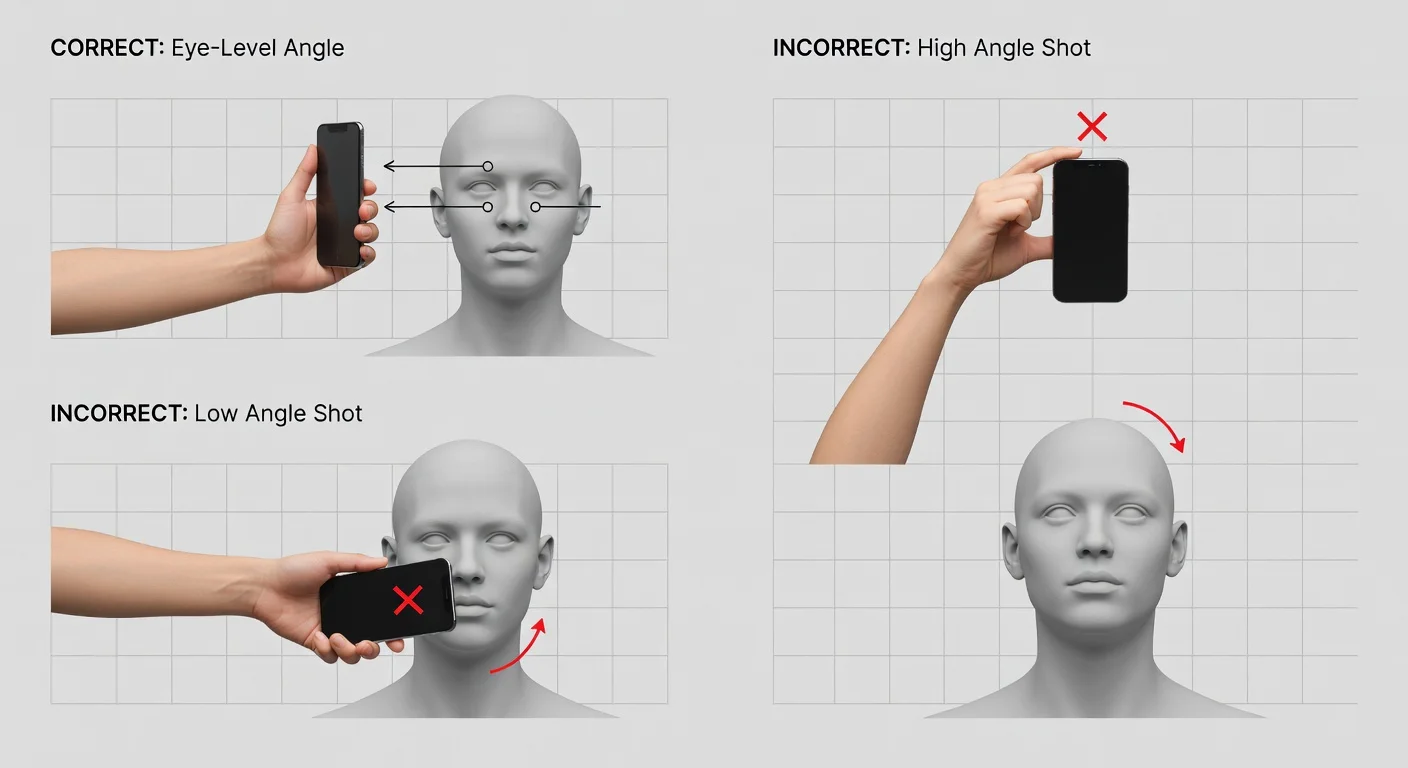
- Angle: Hold the phone at eye level. Taking a photo from below creates a double chin effect. From above, it distorts the forehead.
- Expression: Relax your face. Mouth closed, eyes open normally.
- Hair: Pull your hair back. The AI needs to see your ears and jawline to map the face shape correctly.
I tried taking a photo in a dark room and got a 5.2. Ten minutes later, in front of a window, I got a 7.8. The camera lens matters, too—standard 26mm smartphone lenses distort the center of the face slightly. Keep the phone about an arm's length away.
Can AI attractiveness apps show my potential as a 10/10?
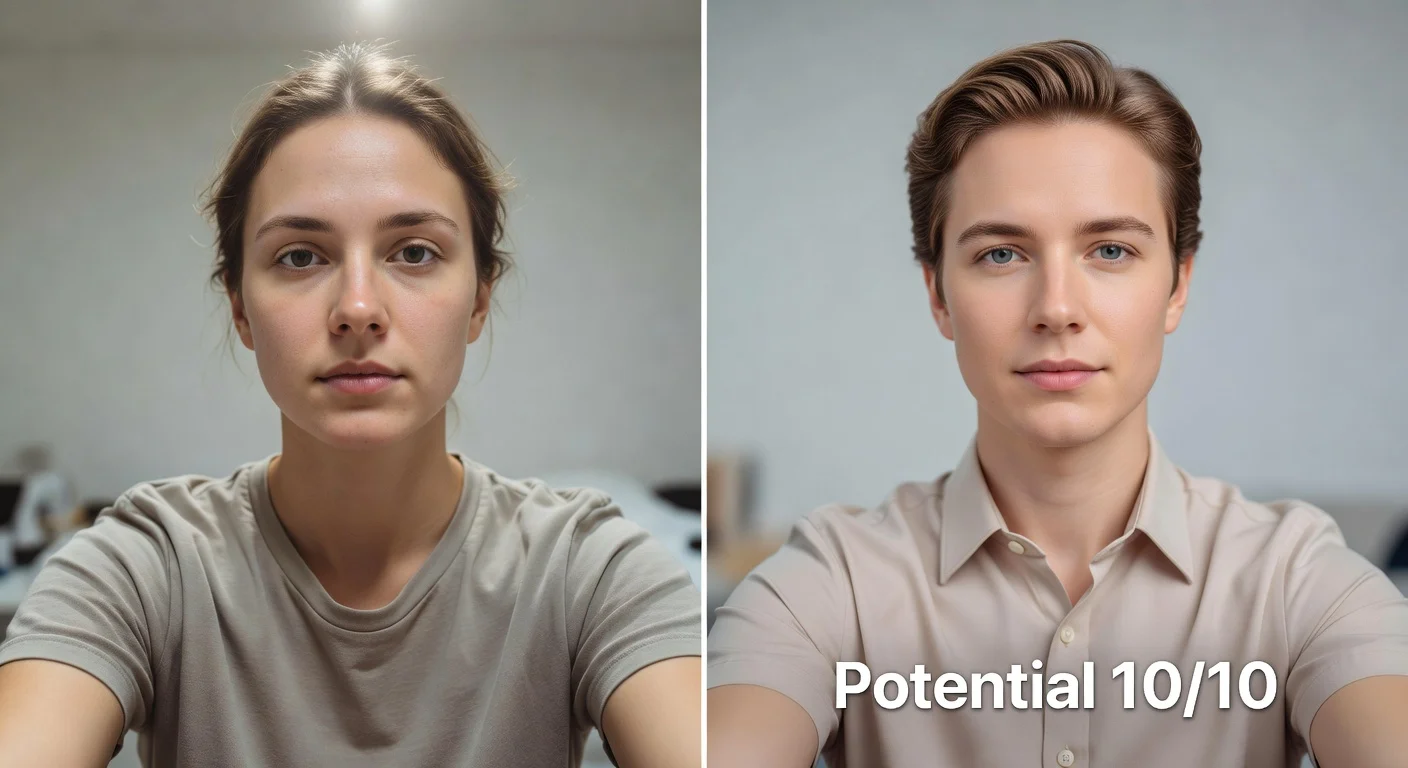
Yes, generative AI can now re-render your face to show your maximum genetic potential. This is a feature I haven't seen in older apps (like the ones from 2023).
This is why I preferred the Glow Up app mentioned earlier. It has a feature where you can see yourself as a "10/10." It generates an image that keeps your core identity—you still look like you—but applies optimal makeup, skin health, and brow styling.
Why this matters:
- Motivation: It validates that you don't need surgery, just better styling.
- Visualization: It’s hard to imagine how a different eyebrow shape changes your face until you see it rendered.
It’s vastly different from standard filters (like on Snapchat or TikTok) which just smear blur over your face. This uses the same diffusion technology found in high-end design software to reconstruct the image.
Do AI attractiveness scores harm mental health?
They can be if you take them as absolute truth rather than data points. If you are already feeling insecure, seeing a "6.4/10" on a screen might sting.
I view these tools as the aesthetic equivalent of a smart scale. A smart scale tells you your body fat percentage. It’s raw data. You can ignore it, or you can use it to track progress.
If you treat a beauty score as a solvable puzzle—"Okay, my skin texture lowered my score, I need a better skincare routine"—it becomes empowering. If you treat it as a judgment on your soul, it’s toxic. Use them responsibly.
Trends shift. As noted in a Vogue Business 2025 article, "imperfections" like tooth gaps or freckles are currently trending again. AI implies symmetry is perfection, but humans often prefer uniqueness.
Does makeup confuse AI attractiveness scanners?
Yes, heavy makeup will artificially inflate your score by masking skin texture and altering perceived contrast. If you want to "hack" the test, putting on eyeliner and contouring your jawline will trick the computer vision into seeing higher contrast and better bone structure.
My advice: Run the test twice.
- Run 1 (The Baseline): No makeup, fresh face. This tells you what you need to work on biologically (skin health, hydration).
- Run 2 (The Potential): With your daily makeup. This tells you how well your current styling maximizes your features.
If there is a massive gap (like a 3-point difference) between the two, you know your makeup game is strong, but your skincare might need attention.
Frequently Asked Questions
How accurate are AI attractiveness tests?
Most modern apps in 2026 are about 85-90% consistent with human consensus on objective metrics like symmetry and skin health, but they often struggle with subjective charm or unique features.
Is there a free app to check my beauty score?
Yes, many apps offer a basic score for free, but detailed breakdowns (like eye canthal tilt or specific skin analysis) usually require a subscription or one-time payment.
Can I actually improve my face rating?
Absolutely. Improving skin texture, reducing bloating, correcting posture, and finding the right grooming style can raise an AI score by 1-2 points.
What is the highest score possible?
Technically 10, but in reality, very few humans score above a 9.5 without retouching. Even supermodels often score in the 8.5 to 9.2 range on strict algorithmic scales.
What is the Golden Ratio face score?
It is a mathematical formula (1.618) traditionally used to measure facial harmony. High-scoring faces have proportions that align closely with this ratio, though it's not the only definition of beauty.