
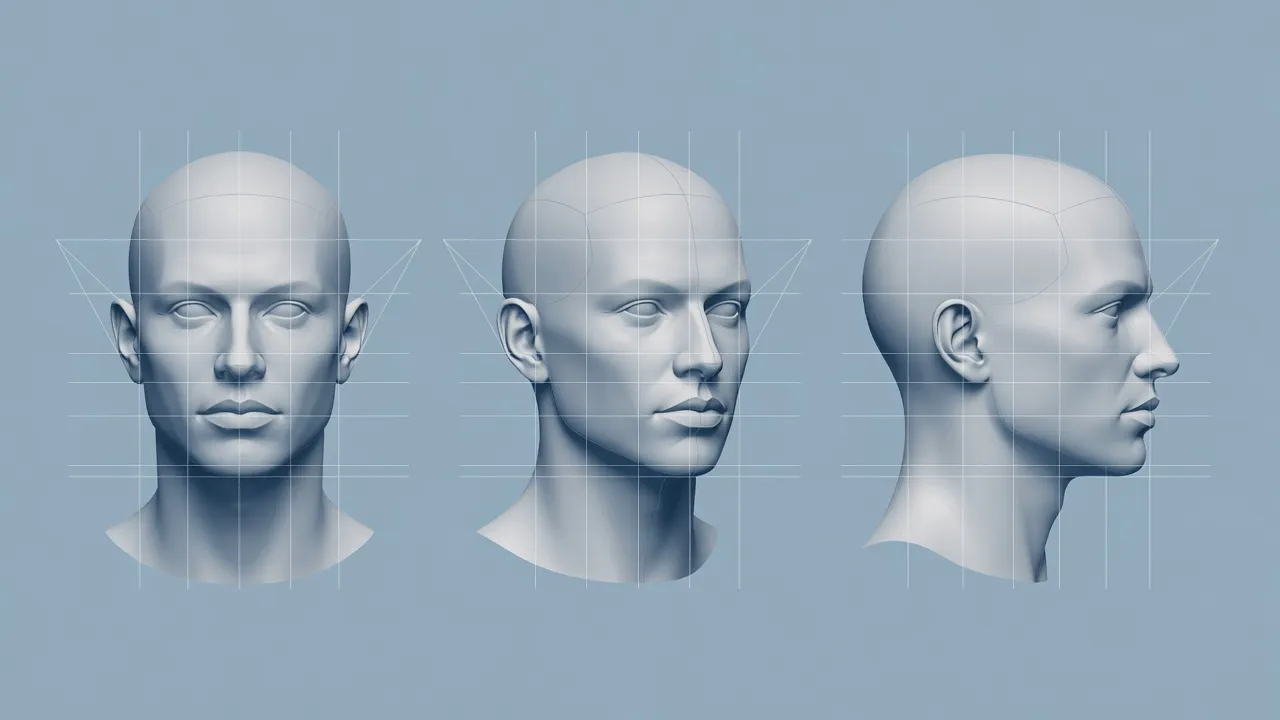
A face angle reference is a standardized visual guide or geometric chart mapping head rotation across pitch, yaw, and roll axes to illustrate human facial anatomy from various perspectives. Artists, 3D animators, cosmetic surgeons, and AI computer vision systems rely on these reference frameworks to maintain consistent structural proportions when viewing a head from frontal, profile, or intermediate angles.
Traditional drawing guides relied on static turnaround sheets created by illustrators. As of September 2026, modern digital modeling and AI tools generate dynamic 3D head poses on demand, rendering old static grid charts mostly out of date. Whether you are drawing a character, evaluating orthomorphic symmetry, or checking your own camera angles, understanding facial angles prevents perspective distortion.
For quick facial evaluations without manually plotting grid lines, tools like the Glow Up & Attractiveness Test allow you to snap a selfie and receive a detailed face analysis powered by a fine-tuned AI model.
What is a face angle reference?
A face angle reference is an anatomical or spatial diagram that shows how facial feature positions change as the head rotates in 3D space. It establishes consistent landmarks like the eye line, nose bridge, and jawline across different rotations. Without a structured reference, artists and vision models frequently miscalculate depth and slant.
| Axis | Direction |
|---|---|
| Pitch | Up / Down |
| Yaw | Left / Right |
| Roll | Tilt Side |
Pitch is positioned vertically above and below the Yaw axis. Yaw is positioned horizontally left and right of the center. Roll is positioned vertically below the Yaw axis.
What are the primary axes used in facial orientation?
Facial orientation relies on three rotational axes: yaw (horizontal panning left or right), pitch (vertical tilting up or down), and roll (leaning sideways toward a shoulder). Yaw alters feature overlap, pitch compresses or expands vertical spacing, and roll tilts the horizontal eye line.
In computer vision, tracking these axes is known as pose estimation. According to documentation on head pose analysis from Wikipedia, calculating pitch, yaw, and roll enables software to map 2D photo pixels back to a 3D facial mesh.
Why do artists and facial analysts need reference sheets?
Reference sheets prevent perspective errors by giving creators fixed geometric anchors for the features as the head turns. When a head turns away from the camera, foreshortening compresses the far side of the cheek, nose, and eye socket.
Without an accurate angle guide, drawings look flat or asymmetric. Facial analysts also need these references because a slight head tilt alters perceived chin sharpness and eye spacing, leading to inconsistent evaluations if the angle is not factored in.
How do core face angles differ in portraiture and visual analysis?
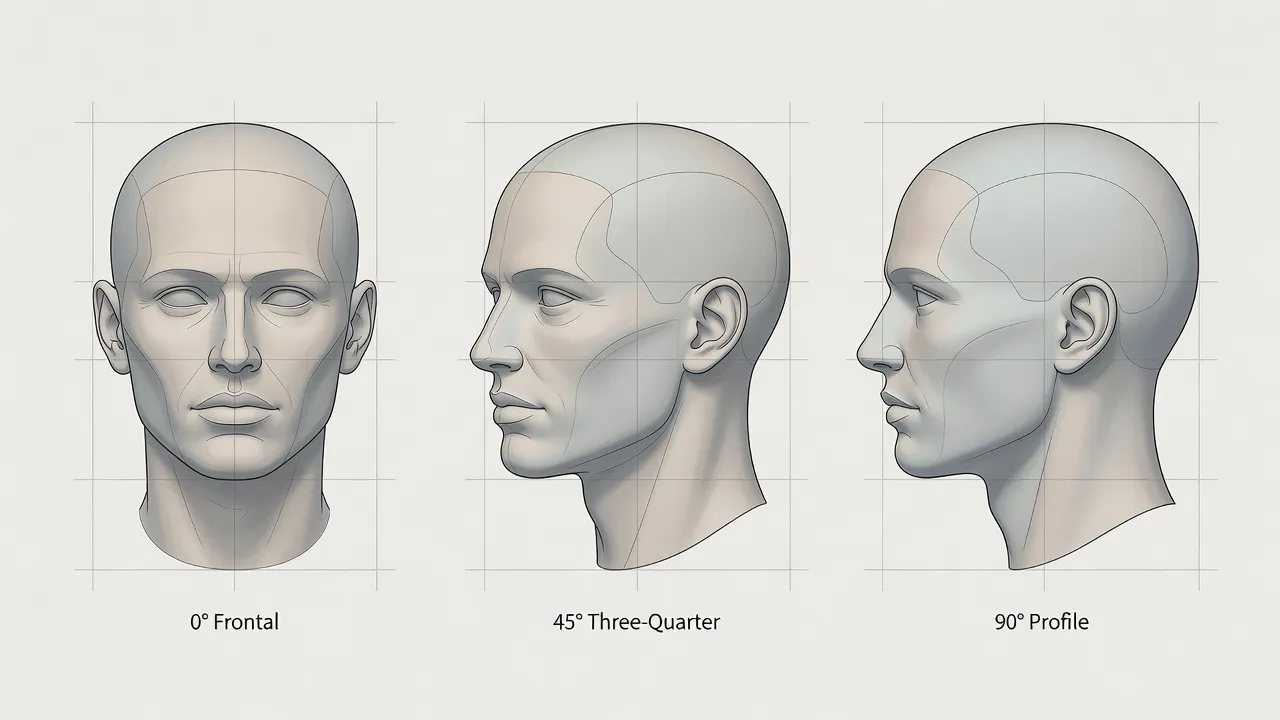
Core facial angles alter feature visibility through foreshortening, plane shifting, and background overlap. The three primary landmark positions are the frontal view, the three-quarter view, and the profile view.
What defines the frontal view (0 degrees)?
The frontal view occurs at 0 degrees yaw and pitch, presenting full bilateral symmetry where both ears, eyes, and nostrils are equally visible. This angle provides an uncorrupted view of broad proportions, making it the standard baseline for passport photos, medical charts, and symmetry tests.
However, a pure 0-degree angle flattens depth. Features like cheekbone projection and nose bridge height are harder to measure from the front because shadow depth is minimal under direct lighting.
How does the three-quarter angle (30 to 45 degrees) reveal depth?
The three-quarter view turns the head 30 to 45 degrees away from the center, revealing cheek contour, jaw depth, and nose projection in a single image. This is widely considered the most flattering portrait angle because it breaks the boxy look of a flat frontal shot.
At 45 degrees, the far side of the face narrows significantly due to perspective foreshortening. Understanding how the planes of the face shift at this rotation helps artists draw realistic jawlines and prevents photographers from placing main lights in flat, unflattering positions.
What makes the profile view (90 degrees) distinct?
The profile view turns the head a full 90 degrees, displaying a pure side silhouette that highlights brow projection, nasal angle, lip posture, and jawline structure. It completely hides the far side of the face.
Orthodontists and surgeons rely heavily on profile angles to analyze bite alignment and chin recency. If you want to study your lateral jaw structure, taking a clean face side profile photo against a simple backdrop isolates bone structure from frontal distraction.
What has changed in facial angle mapping for 2026?
Facial angle mapping has evolved from static 2D grid drawings into real-time 3D landmark mesh detection. Historically, artists spent hours building manual turnaround sheets using rigid wooden mannequin heads or basic skull models.
In 2026, modern computer vision algorithms track up to 468 distinct facial mesh points in real time. This shift allows instantaneous angle correction, turning any mobile camera into a accurate scanning device.
How do AI vision models process pitch, yaw, and roll?
AI vision models process head movement by detecting key facial landmarks (like eye corners and nose tips) and solving for rotational matrix equations. The software estimates the exact rotational degrees relative to the camera lens.
This automated geometry allows apps to normalize lighting and perspective distortion. For instance, if your head is tilted 15 degrees upward, an advanced model compensates for the altered eye-to-chin distance before scoring facial geometry.
Can dynamic angle tracking replace manual reference sheets?
Yes, dynamic angle tracking offers continuous 360-degree feedback that static reference sheets cannot replicate. Instead of guessing how a nose looks at 35 degrees tilt versus 40 degrees, dynamic software renders the exact angle continuously.
For users exploring personal aesthetics, the Glow Up & Attractiveness Test uses a fine-tuned AI model to evaluate facial structure from simple selfies. The application analyzes key facial proportions regardless of subtle angle variations, delivering personalized scores and tailored tips to beautify your look without requiring studio setup photos.
| Face Angle Degree | Primary Yaw Range | Anatomical Visibility | Common Technical Application |
|---|---|---|---|
| Frontal (Full Face) | 0° to 10° | Both eyes, ears, cheeks, and nostrils fully visible | Passport photos, symmetry checks, ID cards |
| Slight Turn | 15° to 25° | Both eyes visible; far ear disappears behind head | Portrait photography, beauty headshots |
| Three-Quarter | 30° to 45° | Nose tip aligns near far cheek edge; far eye shortened | Concept art, character design, aesthetic review |
| Extreme Angle | 60° to 75° | Far eye partially obscured; nose breaks cheek boundary | Dramatic lighting, graphic illustration |
| Profile (Side View) | 85° to 90° | Single eye, one ear, full silhouette of nose and jaw | Cephalometric analysis, jawline assessment |
Why does face angle alter perceived facial proportions?
Changing the head angle distorts optical depth by altering line-of-sight distance between facial landmarks. A camera lens positioned close to a subject magnifies central features like the nose while pushing edge features like ears further away.
Tilt also changes how light casts shadows across plane boundaries. Downward tilt darkens eye sockets while hiding chin depth, whereas upward tilt elongates the neck and broadens jawline width visually.
How does head tilt alter the face width height ratio?
Tilted head positions compress or extend vertical distance, skewing measured mathematical ratios. Tilting the forehead toward the camera decreases visible jaw height, artificially narrowing lower face height.
Researchers analyzing facial metrics emphasize consistent pitch alignment. A study published by the National Center for Biotechnology Information highlights that small rotational errors corrupt measurement accuracy in facial aesthetic evaluations. Tilting upward skews the standard face width height ratio, making a face appear broader than it is in flat orthographic view.
How does side angle affect profile symmetry?
Even a 5-degree off-center yaw rotation creates artificial asymmetry in 2D photographs. One eye appears wider than the other because it sits closer to the lens focal point.
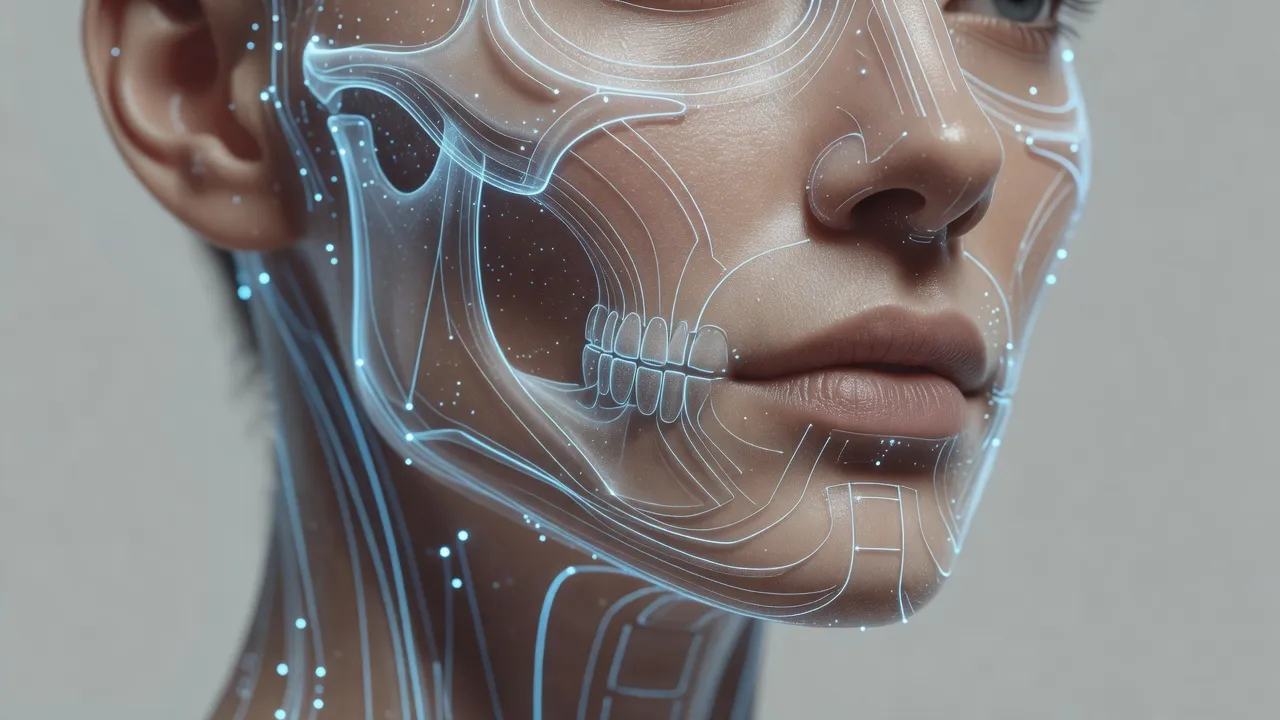
True physical asymmetry must be measured with identical head rotation on both sides. When examining the face symmetry of celebrities, high-end agencies use strict studio alignment tools to ensure light and yaw match perfectly before drawing vertical symmetry axis lines.
How can you use angle references to evaluate facial harmony?
To evaluate facial harmony accurately, you must capture consistent anchor photos across frontal, three-quarter, and profile positions. Comparing random selfies taken at varying arm lengths and tilts introduces perspective distortion that obscures real geometry.
A proper reference evaluation requires fixed camera distances (at least 5 feet away with optical zoom) to eliminate wide-angle barrel distortion.
What role does facial rotation play in automated analysis?
Automated facial analysis uses rotational geometry to re-center tilted photos into normalized spatial grids. This normalizes camera angle quirks so structural features are evaluated fairly.
The Glow Up & Attractiveness Test iOS app applies AI analysis directly to your uploaded photos. For $9.99/week, the app evaluates facial features from your selfies, delivers customized beauty guidance, and even includes AI image generation features so you can see yourself as a 10/10.
How do plane shifts impact shading and contours?
When the head turns, light transitions across cheek planes alter where shadows fall, changing how soft or hard facial contours appear. A soft jawline can look razor-sharp at a 35-degree angle under directional lighting because the inferior mandibular border catches strong shadow separation.
Illustrators use classic drawing methods to map these light shifts. As detailed in the classic art guide on facial proportions on Wikipedia, mapping human facial planes as simple block surfaces first ensures shading stays realistic regardless of how far the head rotates away from the viewer.
Frequently Asked Questions
What is the most flattering face angle for photos?
The three-quarter angle, turned roughly 30 to 45 degrees away from the camera, is widely considered the most flattering face angle. It adds depth, highlights cheekbones, and defines the jawline better than a flat frontal view.
How do yaw, pitch, and roll differ in head pose estimation?
Yaw refers to turning the head side-to-side (left or right). Pitch refers to tilting the head up or down. Roll refers to leaning the head sideways toward either shoulder.
Why does my face look crooked in selfies taken at an angle?
Selfies captured close to the camera suffer from focal length distortion. When combined with a slight head tilt or off-center yaw angle, features closer to the lens appear noticeably larger, creating artificial asymmetry.
What camera angle makes your jawline look sharper?
A camera angle positioned slightly above eye level combined with a mild three-quarter head turn highlights jawline definition. Extending the chin slightly forward prevents skin compression near the neck.
How do 3D animators use face angle references?
3D animators use turnarounds and facial landmark reference grids to maintain mesh proportions as character heads rotate. This ensures blend shapes and expressions remain natural across all camera angles.
Can AI accurately analyze my face if my selfie is tilted?
Modern fine-tuned AI models calculate pitch, yaw, and roll metrics to adjust for minor head tilts. While extreme turns hide features, small angles are easily compensated for during computational analysis.
What is a turnaround reference sheet?
A turnaround reference sheet is an illustration showing a character or subject from front, back, profile, and three-quarter angles. Artists use it to ensure visual consistency across scenes.