
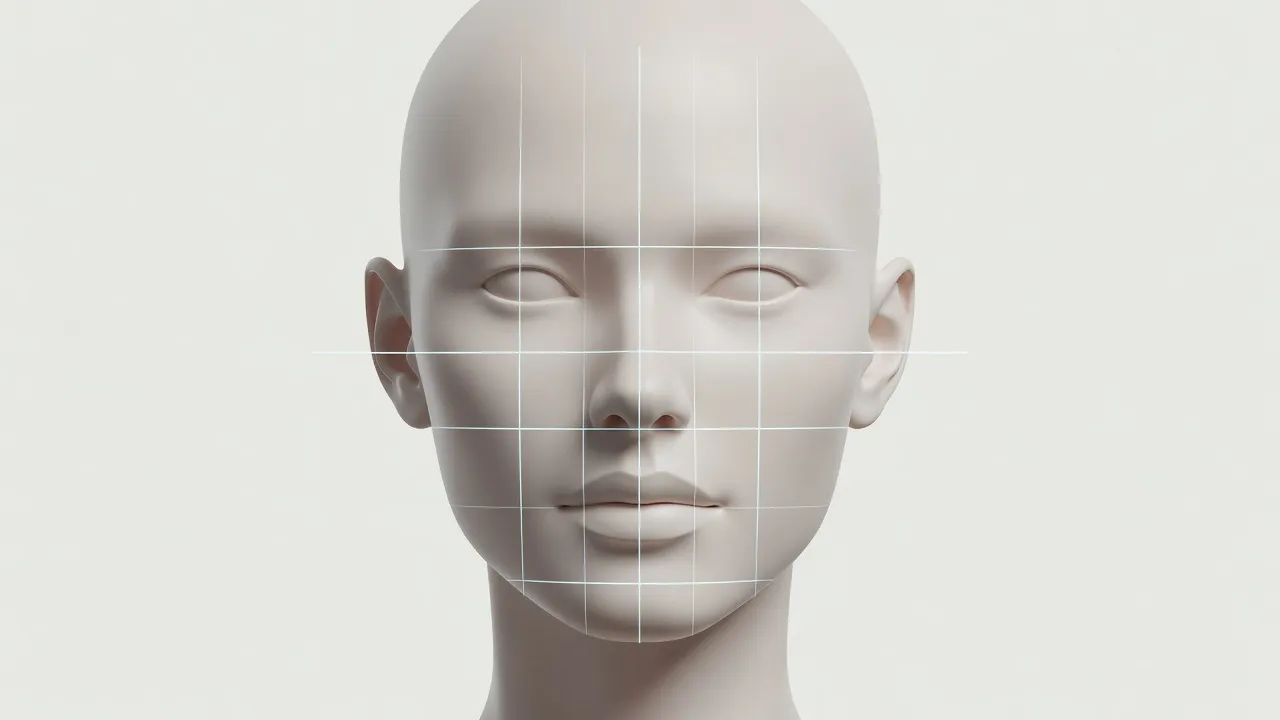
Facial width-to-height ratio (fWHR) is the distance between the left and right cheekbones divided by the vertical distance between the upper lip and eyebrows. Unlike overall head length, this metric measures the relative squareness of the central face, serving as a standard index in evolutionary psychology, anthropometry, and facial aesthetics.
Most discussions around facial proportions mix up general head shape with internal facial metrics. If you measure from your chin to your hairline, you are calculating total facial height, not fWHR. Getting this distinction wrong causes people to miscalculate their proportions by up to 30%, leading to bad styling choices and distorted self-assessments.
Understanding how fWHR is calculated, what average baseline scores mean, and how camera distortion affects your results allows you to evaluate your facial geometry with scientific precision.
What is the definition of facial width-to-height ratio (fWHR) using bizygomatic width and upper face height?
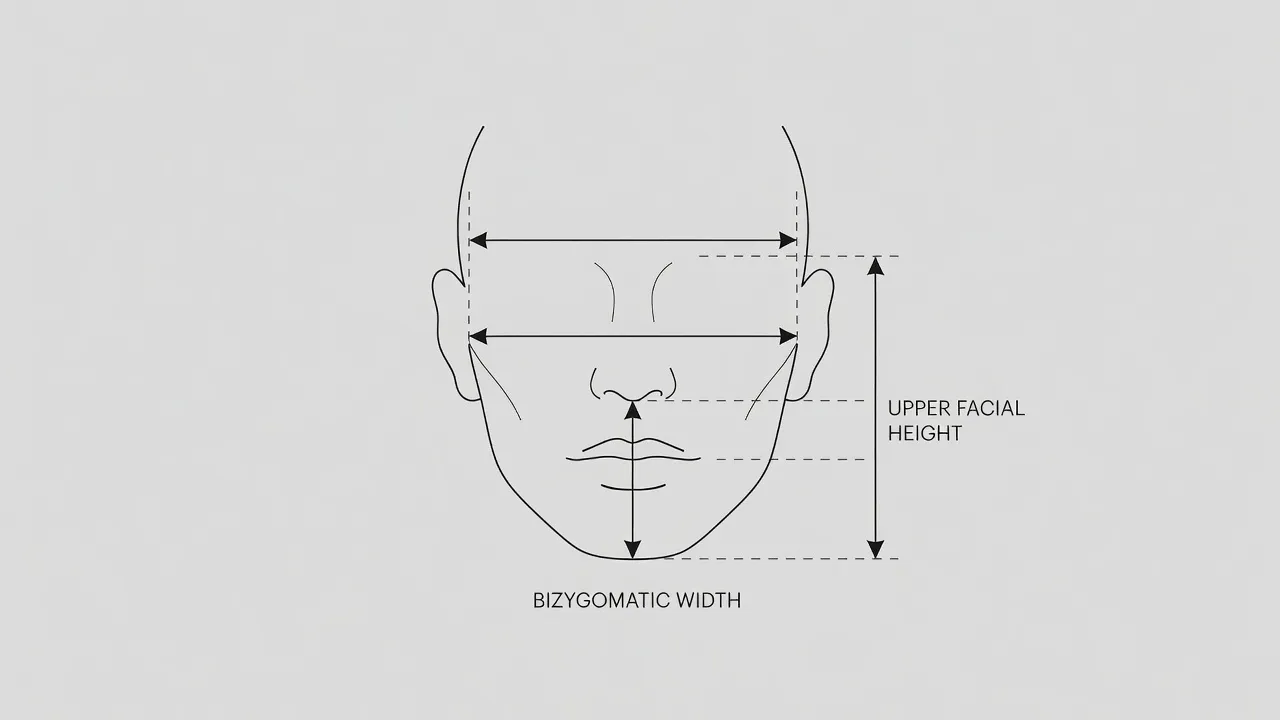
Facial width-to-height ratio (fWHR) is defined as the horizontal distance between the outer points of the cheekbones (bizygomatic width) divided by the vertical distance from the upper lip to the brow line (upper face height). This metric isolates the central frame of the midface from variable traits like jawline length, chin depth, and hairline height.
fWHR = Bizygomatic Width / Upper Face Height
In academic studies, researchers measure this proportion to analyze facial dimorphism, perceived dominance, and cranial structure. Because the lower jaw and forehead can vary significantly due to age, body fat, or hair placement, isolating upper face height gives a stable baseline for skeletal architecture.
A high fWHR indicates a wide, compact midface, whereas a low fWHR reflects a narrower, longer midface structure.
How do you measure facial width-to-height ratio (fWHR) using landmarks like bizygomatic width, nasion, prosthion, and stomion?
To measure fWHR, scientists locate the widest point across the zygomatic arches for width and calculate the vertical span between specific skeletal or soft-tissue anatomical landmarks.
Depending on whether researchers are working with dry skulls or living human photographs, the precise landmark points differ slightly:
- Bizygomatic Width (Horizontal): The distance between the most lateral points of the zygomatic arches ( cheekbones). On photographs, this is measured as the maximum horizontal line across the face perpendicular to the mid-sagittal plane.
- Nasion to Prosthion (Skeletal Vertical): On dry skulls, upper face height is measured from the nasion (the intersection of the frontal and nasal bones) down to the prosthion (the lowest point of the alveolar arch between the upper central incisors).
- Brow to Stomion (Photographic Vertical): On digital photographs, researchers mark the line connecting the highest points of the eyebrows (or the nasion landmark) down to the stomion (the point where the lips meet) or the top of the upper lip margin.
| Landmark Metric | Anatomical Boundary | Significance in Calculation |
|---|---|---|
| Bizygomatic Width | Left zygoma to right zygoma (outer cheekbones) | Numerator: defines total midface width |
| Nasion | Junction of frontal and nasal bones (brow area) | Upper vertical boundary for skeletal measurements |
| Prosthion / Stomion | Superior alveolar margin or lip junction line | Lower vertical boundary for midface height |
| Total Facial Height | Trichion (hairline) to Gnathion (bottom of chin) | Excluded from fWHR; used in overall Facial Index |
When taking manual measurements from photos, standardizing your photo setup is mandatory. Taking a picture too close to your camera artificially warps cheekbone width due to spherical perspective distortion.
What is the average facial width-to-height ratio (fWHR) value (e.g., 1.8 to 2.0)?
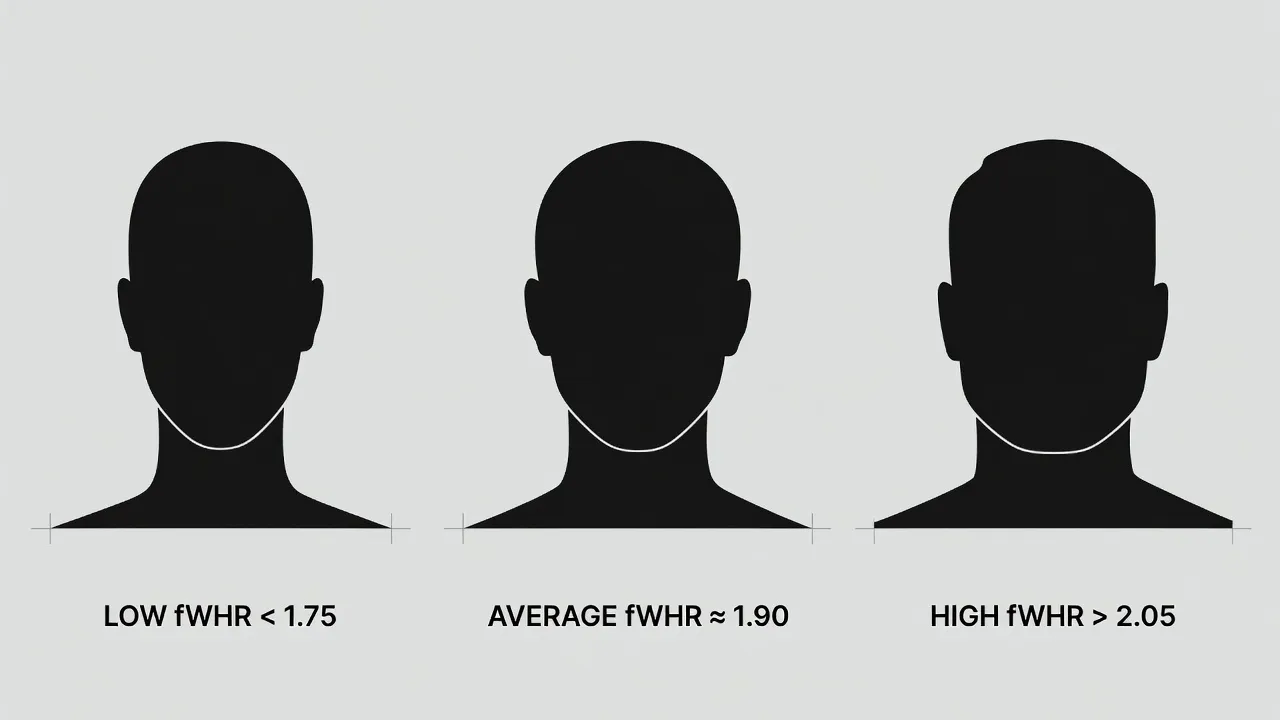
The average facial width-to-height ratio across general human populations typically ranges between 1.80 and 2.00. Individual values outside this window occur regularly, but scores below 1.70 represent distinctly elongated midfaces, while scores above 2.10 indicate exceptionally broad, compact midfacial structures.
According to research documented on Wikipedia's fWHR entry, facial ratio distributions cluster tightly around this central 1.80–2.00 corridor across diverse ethnic groups.
Because fWHR is a relative ratio rather than an absolute length in millimeters, a tall person and a short person can possess identical fWHR values if their cheekbone width scales proportionally with their midface height.
What mean fWHR value did the Carré & McCormick study find?
In their landmark 2008 study, researchers Justin M. Carré and Cheryl M. McCormick found an average fWHR of approximately 1.97 to 2.08 across their sampled groups.
published in the Proceedings of the Royal Society B, investigated whether facial structure correlated with aggressive behavior in varsity ice hockey players and undergraduate students. The researchers recorded mean ratios near 1.97 for female undergraduates, 2.02 for male undergraduates, and up to 2.08 among professional athletes.
| Sample Group (2008 Study) | Sample Size (n) | Mean fWHR Value |
|---|---|---|
| Female Undergraduates | 37 | 1.97 (+/- 0.12) |
| Male Undergraduates | 50 | 2.02 (+/- 0.15) |
| Professional Hockey Players | 88 | 2.08 (+/- 0.18) |
This study kicked off nearly two decades of research into whether higher testosterone exposure during puberty expands bizygomatic bone growth relative to upper facial height. While follow-up studies have debated the strength of behavioral links, the baseline range established by Carré and McCormick remains the reference benchmark in facial metrics literature.
What are typical fWHR values for men and women?
Typical fWHR values for both men and women fall between 1.80 and 2.05, with men displaying a slightly higher mean in some populations due to testosterone-driven lateral cheekbone expansion.
While early evolutionary psychology studies claimed fWHR was strongly sexually dimorphic, modern large-scale anthropometric analyses show significant overlap between sexes:
- Typical Male Range: 1.85 to 2.05. Higher values are often linked with wider zygomatic arches and heavy masseter muscle development.
- Typical Female Range: 1.80 to 2.00. Female faces frequently present softer soft-tissue boundaries, though skeletal ratios match male distributions closely.
Because soft tissue overlay can mask underlying bone structure, evaluating overall facial harmony requires analyzing more than a single numerical ratio. Factors like your face side profile, jawline angle, and cheekbone prominence play equal roles in visual perception.
What mistakes ruin accurate fWHR self-measurement?
The most common mistake when measuring fWHR is taking photos with a smartphone camera from less than five feet away. Lens distortion at close range skews your proportions, making your nose look larger and your cheekbone width appear narrower than it actually is.
If you are trying to calculate your ratio at home, these four errors will invalidate your numbers:
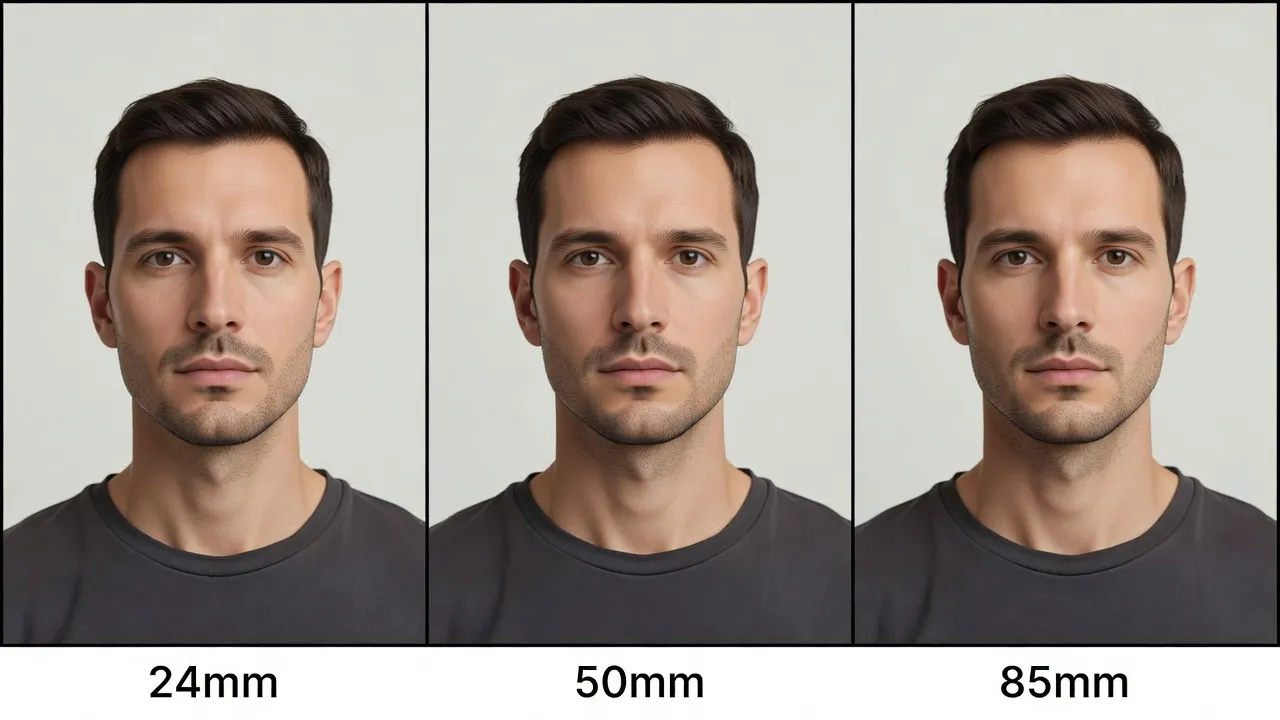
- Selfie Perspective Distortion: Front-facing smartphone lenses (typically 24mm to 28mm equivalent focal length) distort facial depth when held at arm's length.
- Tilted Head Angle: Tilting your head back by just five degrees shortens the vertical measurement between brow line and upper lip, artificially inflating your fWHR score. Check your vertical alignment using a reference guide on proper face angle positioning before taking measurement photos.
- Facial Expressions: Smiling pulls the cheekbones laterally and compresses upper face height. You must maintain a neutral facial expression with resting lips.
- Confusing Hairline for Brow Line: Starting your vertical measurement at the hairline instead of the eyebrow ridge measures total facial height rather than upper face height.
| Error Source | Impact on Measured fWHR | Correction Method |
|---|---|---|
| Smartphone focal distortion | Decreases fWHR by 5% to 12% | Stand 6-8 ft away; use 2x-3x optical zoom |
| Head tilted upward | Artificially inflates fWHR score | Align lens level with eye line |
| Smiling / Active jaw | Distorts cheek width & lip distance | Maintain neutral, un-clenched expression |
| Incorrect upper landmark | Deflates ratio by including forehead | Measure strictly from brow ridge line |
To eliminate camera lens errors, use photos taken from at least six feet away using a telephoto lens (85mm equivalent), or rely on automated analysis tools built to calibrate optical geometry.
If you want an accurate, instant evaluation of your facial metrics without doing manual pixel math, the Glow Up & Attractiveness Test app allows you to snap a selfie, receive a detailed face analysis powered by a fine-tuned AI model, and get a personalized beauty score with tailored tips to optimize your look.
How does camera focal length distort fWHR in photos?
Camera focal length distorts fWHR by changing perspective distance: wide-angle lenses (under 35mm) narrow the perceived cheekbone width, while telephoto lenses (85mm–200mm) flatten the face and reveal accurate width ratios.
A 2018 study published by the American Society of Plastic Surgeons demonstrated that selfies taken from 12 inches away increase perceived nasal volume by 30% while compressing lateral facial features compared to photos taken from 5 feet away.
| Focal Length | Appearance | Effect on fWHR |
|---|---|---|
| 24mm (Selfie) | Face looks narrow, nose looks large | Distorted fWHR |
| 85mm (Portrait) | True skeletal fWHR proportions revealed | Accurate fWHR |
If you evaluate your face using standard close-up camera shots, you are measuring lens artifacts rather than your true biological fWHR. Always rely on portrait-distance shots taken in natural lighting.
fWHR vs. General Facial Aesthetics: What does the ratio actually tell you?
Facial width-to-height ratio measures midface compactness, but it does not determine overall facial attractiveness on its own. A balanced face relies on a harmony of multiple proportions, including symmetry, jaw width, eye spacing, and facial height ratios.
While pop-culture fashion forums focus on achieving an "ideal" fWHR around 1.90, cultural standards vary significantly around the world. For instance, preferences highlighted in studies on korean standards of beauty often favor a slender, V-line lower face over a high fWHR square midface structure.
| Metric | Primary Measurement focus | Aesthetic Association |
|---|---|---|
| fWHR (Width-to-Height) | Cheekbone width / Upper lip-to-brow | Compactness, perceived dominance |
| Facial Index | Total head height / Bizygomatic width | Overall head shape (Long vs. Round) |
| Golden Ratio (Phi / 1.618) | Vertical third proportions | Classical balance and harmony |
| Interpupillary Distance | Distance between pupil centers | Eye spacing balance |
As of September 2026, computational facial analysis software relies on multi-point landmark meshes rather than single ratios to evaluate facial aesthetics. A broad fWHR paired with a weak chin yields a completely different visual result than the exact same fWHR paired with strong lower jaw symmetry.
What haircuts and styling choices complement your fWHR score?
Styling choices should balance your natural fWHR: high fWHR faces benefit from hairstyles that add vertical length, while low fWHR faces suit cuts that create lateral volume at the cheekbones.
If you want to optimize your visual proportions based on your facial metrics, structure your look using these principles:
High fWHR (> 2.00: Compact, Wide Face)
- Hair Goals: Add vertical height on top to elongate the total facial profile.
- Recommended Cuts: High-top fades, layered shags, volumetric pixie cuts, or long layers with volume at the crown.
- Eyewear: Rectangular or narrow frames that cut across the width of the face.
- Styling Tips: Selecting proper haircuts based on face shape helps balance midface width without accentuating heaviness.
Low fWHR (< 1.75: Elongated, Narrow Face)
- Hair Goals: Add lateral volume at the sides to widen the midface visual field.
- Recommended Cuts: Chin-length bobs, curtain bangs, full side waves, or textured shoulder-length cuts.
- Eyewear: Wide, oversized, or round frames that extend slightly beyond the widest part of your cheekbones.
- Styling Tips: Avoid high-top pompadours or slicked-back flat sides that make the midface appear longer.
How to track your glow up and facial symmetry accurately
Understanding your facial metrics gives you a baseline for personal grooming, makeup placement, and styling. However, taking manual measurements with calipers or digital photo editing software is tedious and prone to human error.
If you want an instant, accurate analysis of your facial geometry, download the Glow Up & Attractiveness Test app on iOS.
  1. Snap a clear selfie under neutral lighting
  2. Get instant AI facial landmark & ratio calculations
  3. Receive custom styling, skincare, and beauty recommendations
The app processes your photo through an AI model tuned specifically for facial aesthetics. It calculates key ratios, delivers a personalized rating score, and provides a customized glow-up guide to help you bring out your best features.
Frequently Asked Questions
Can you change your fWHR naturally without surgery?
No, you cannot alter your bone structure naturally after facial growth finishes post-puberty. However, reducing body fat percentage removes soft-tissue fullness over the cheekbones, which can refine how wide your midface appears. Additionally, masseter muscle hypertrophy from jaw exercises can subtly widen the lower face profile.
Is a higher or lower fWHR considered more attractive?
Neither a high nor a low fWHR is universally more attractive. High fWHR scores are often perceived as more dominant or striking, whereas lower fWHR scores are frequently associated with softer, more elongated facial features. Aesthetic appeal depends on how your fWHR interacts with your jawline, eyes, and overall facial symmetry.
Why do selfies make my fWHR look different than in the mirror?
Selfies taken with front-facing camera lenses cause perspective distortion because the camera sits close to your face. This distorts the spatial relationship between your central features and outer cheekbones, artificially narrowing your bizygomatic width. Looking in a mirror reflects real-life light angles without focal lens warping.
Does body fat percentage affect fWHR measurements?
Yes, high body fat percentages deposit soft tissue over the zygomatic arches and buccal areas, which can obscure clear bone landmarks in photographs. Lowering body fat reveals natural cheekbone contours, making horizontal measurement points more distinct.
What is the difference between fWHR and the Golden Ratio?
fWHR specifically measures the ratio between cheekbone width and upper facial height (brow to upper lip). The Golden Ratio (1.618) is a classical proportion applied to multiple facial intervals, such as total facial length compared to width, or eye width compared to inter-pupillary distance.
What tool accurately measures fWHR from a photo?
Digital photo analysis software calibrated for camera distance provides the most precise fWHR readings. Modern mobile applications like Glow Up & Attractiveness Test use trained AI computer vision models to map facial landmarks automatically, bypassing focal length distortion and manual measurement errors.