
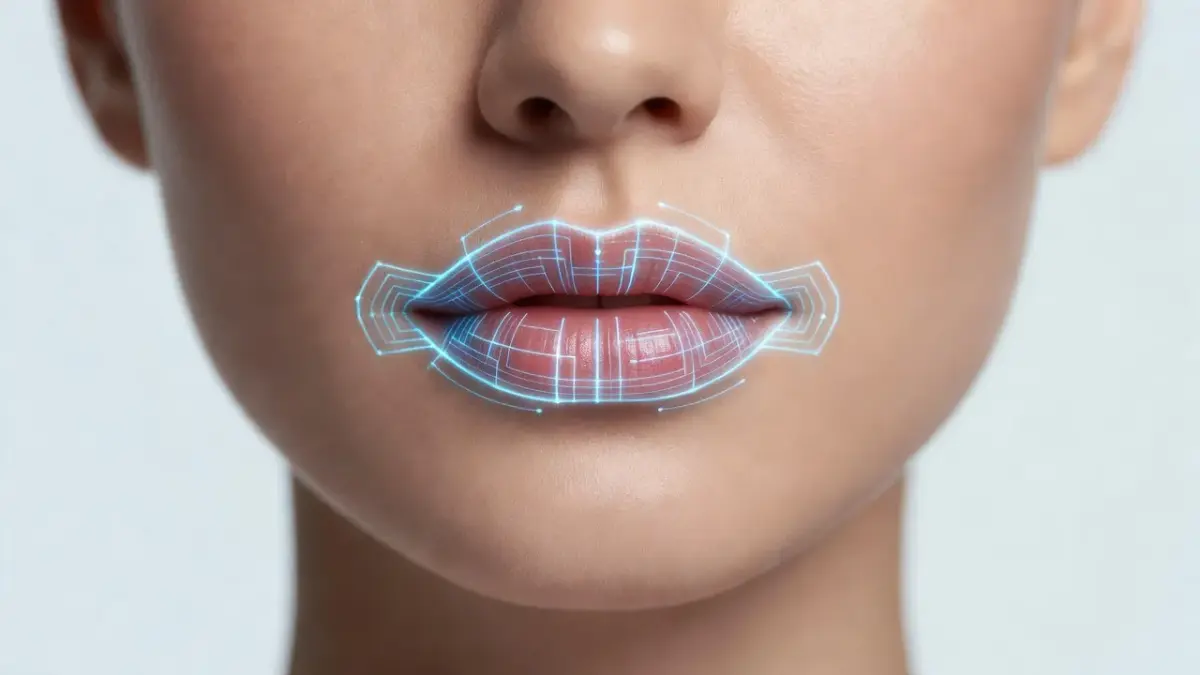
A lip shape detector is an AI-powered computer vision tool that classifies human lip geometry, vermilion border boundaries, and Cupid's bow definition from a single facial photograph. By mapping dozens of spatial coordinate points along the upper and lower lips, these algorithms determine whether a mouth is full, thin, bow-shaped, wide, round, or asymmetric.
If you want to understand how your lip shape fits into your overall facial aesthetics, picking the right analysis tool matters. If you are looking for a complete facial breakdown on iOS, the Glow Up & Attractiveness Test iPhone app analyzes your full facial structure through AI selfie scans, evaluating how your lips balance against your chin, jawline, and cheekbones.
What is a lip shape detector and how does AI facial scanning work?
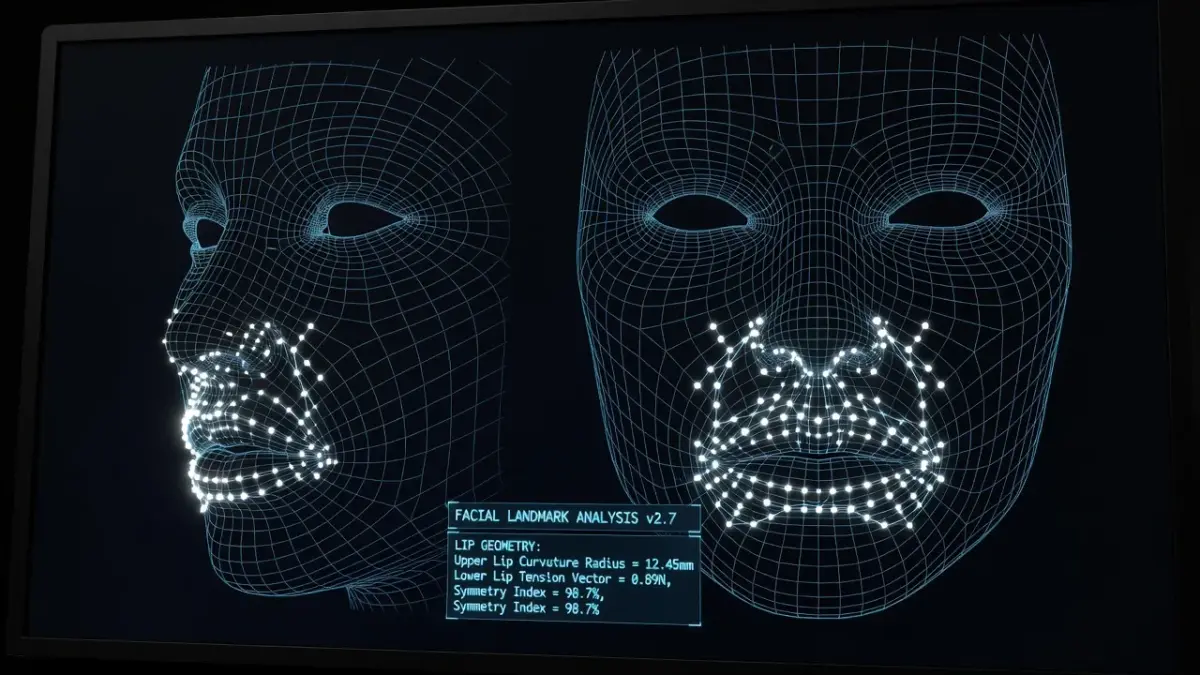
A lip shape detector uses machine learning models and computer vision frameworks to identify the precise boundaries of the human mouth. Rather than relying on simple color filters, modern facial detection algorithms scan for contrast changes, texture gradients, and structural edges around the oral zone.
The core technology relies on facial landmark tracking. Systems such as Google's MediaPipe or custom Convolutional Neural Networks (CNNs) overlay a dense point grid across your face.
The facial analysis process follows four precise technical steps:
- Facial Alignment: The software normalizes your photo, adjusting for tilt, lighting angles, and distance from the camera lens.
- Vermilion Border Segmentation: The algorithm isolates the red tissue of the lips from the surrounding skin tone using color channel analysis and spatial edge detection.
- Landmark Placement: Key anatomical markers are placed at the labial commissures (corners of the mouth), the peaks of the Cupid's bow, the labial tubercle (center top lip), and the lowest point of the lower vermilion.
- Ratio Calculation: The system calculates height-to-width ratios, upper-to-lower volume balances, and symmetry scores across the sagittal plane.
Understanding these algorithmic steps explains why lighting and camera angles heavily influence your scan results. Small shifts in perspective can alter how an algorithm measures your lip height relative to your lower jaw.
How AI face analysis tools map lip shapes and facial proportions
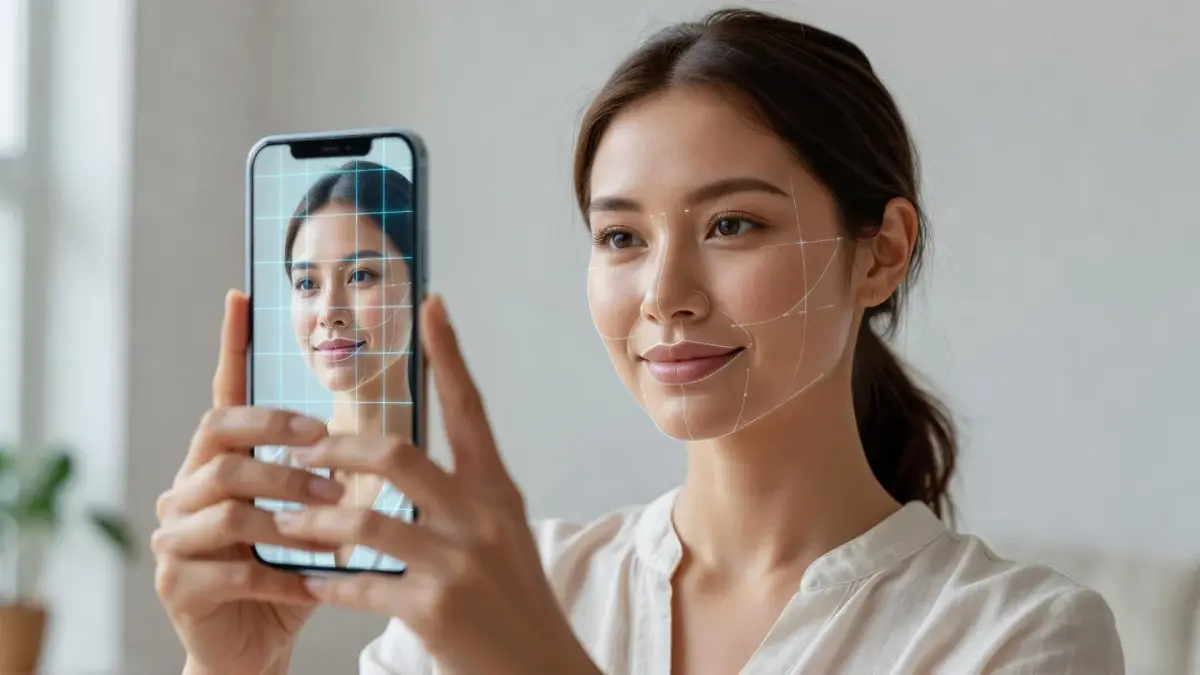
AI face analysis tools map lip shapes by comparing your labial dimensions against standardized geometric databases and facial proportion scales. Rather than judging lips in isolation, advanced algorithms evaluate how the mouth interacts with neighboring features like the philtrum column, nose base, and chin tip.
When evaluating your facial aesthetic, isolated features tell only part of the story. A pair of lips that appears thin on a broad jawline might look completely proportional on a narrower face structure. This interaction between features is why comprehensive AI tools analyze the entire face concurrently.
For women exploring aesthetic optimization, the Glow Up & Attractiveness Test provides a personalized face rating score and detailed facial analysis using a fine-tuned AI model. By uploading a single selfie, you can discover your overall beauty score, evaluate your facial harmony, and follow a tailored glow up guide designed to bring out your best features.
For those interested in how algorithms score full facial structure beyond lip boundaries, reading a broader guide on female AI facial analysis helps clarify how symmetry and ratio algorithms calculate overall attractiveness.
What is the best lip shape detector app?
The best lip shape detector app depends on whether you need virtual product try-ons, plastic surgery simulation, or overall facial harmony scoring. Different platforms specialize in distinct areas, ranging from retail makeup filters to full facial symmetry calculators.
As of November 2026, several consumer applications lead the market in facial landmark scanning and lip classification:
| App / Tool | Primary Use Case | Lip Analysis Features | Pricing Model |
|---|---|---|---|
| Glow Up & Attractiveness Test | Full Female AI Facial Analysis | Maps lip ratios in relation to overall facial symmetry and beauty scores | $9.99/week |
| YouCam Makeup | AR Makeup & Virtual Try-On | 3D real-time vermilion mesh mapping, shape classification, lipstick texture simulation | Free with optional in-app purchases |
| ModiFace | Enterprise Retail Try-On | Live browser and app landmark tracking for shade matching and volume estimation | Free on brand partner sites |
| Lipcurl | Dedicated Lip AR Analysis | Real-time augmented reality lip height-to-width measurement | Free entry tier |
For users looking to evaluate how their lips affect overall facial harmony, a comprehensive tool delivers more actionable insights than a simple lipstick filter. If you want to dive deeper into software options across the market, check out this review of AI face rating apps to see how various platforms compare.
How do you determine your lip shape?
You determine your lip shape by measuring three critical anatomical points: the ratio of upper-to-lower lip thickness, the sharpness of your Cupid's bow, and the overall width of your mouth compared to your eyes.
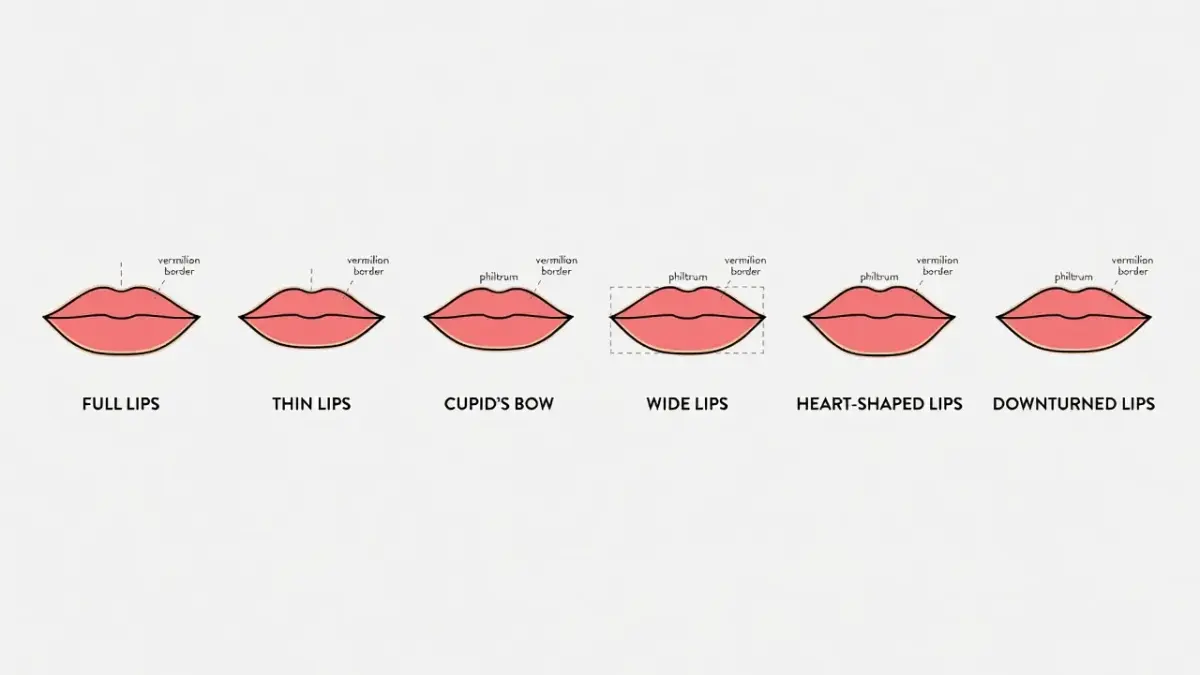
To categorize your mouth shape manually without digital software, look into a mirror with a neutral expression and check against these six standard classifications:
- Full Lips: Both the upper and lower lips are plump, pronounced, and hold roughly equal volume from corner to corner.
- Heavy Upper Lip: The top lip carries noticeably more volume and extends further outward than the bottom lip.
- Heavy Lower Lip: The bottom lip is significantly larger or deeper than the upper lip, drawing the visual weight downward.
- Thin Lips: Both upper and lower vermilion borders are narrow, with minimal natural projection or vertical depth.
- Bow-Shaped (Cupid's Bow): The two upper peaks of the top lip are sharply defined, creating a distinct "V" shape in the center.
- Down-turned Lips: The outer corners (commissures) drop slightly lower than the central lower border when resting.
If you are trying to classify your facial structure accurately, combining a manual check with a structured face shape analysis guide will ensure you do not mistake camera distortion for genuine facial asymmetry.
Does YouCam Makeup have a lip shape detector?
Yes, YouCam Makeup includes an AI-driven lip shape detector built directly into its augmented reality engine. Developed by Perfect Corp, the application uses a 3D facial mesh to identify lip contours, edge boundaries, and volume distribution in real time.
When you open the live camera mode or upload a photo, YouCam's facial detection algorithms map over 50 specific points around the mouth area. This allows the app to automatically detect whether your lips are full, thin, or asymmetrical before applying virtual lipstick finishes.
Beyond simple color overlays, the software detects texture variations across the vermilion surface. This feature prevents virtual glosses or matte lipsticks from bleeding over the skin boundary, making it one of the most widely integrated commercial try-on engines in beauty tech.
Does ModiFace offer a lip shape analyzer or virtual try-on?
Yes, ModiFace offers advanced lip shape tracking and virtual try-on modules through its enterprise augmented reality platform. Acquired by L'Oréal, ModiFace provides the underlying computer vision tech for hundreds of global retail applications, including Sephora and Maybelline.
ModiFace's lip analysis engine relies on deep neural networks trained on tens of thousands of diverse facial images. The software tracks live video frames to map the exact perimeter of the lips, accounting for facial movement, speaking, and lighting shifts.
Unlike consumer-facing fun apps, ModiFace focuses on hyper-realistic shade and texture representation. Its algorithms evaluate your natural lip pigmentation alongside your structural shape, adjusting virtual lipstick transparency to show how products will look over your natural base tone.
What is lip mapping and how is it used to analyze lip shape?
Lip mapping is a systematic diagnostic technique where an aesthetician, injector, or software algorithm draws reference lines across the mouth to measure symmetry, volume distribution, and anatomical proportions.
In both clinical aesthetics and digital face analysis, proper mapping relies on key anatomical landmarks defined in medical literature, such as those cataloged on Wikipedia's lip anatomy guide:
- Labial Commissures: The left and right junction points where the upper and lower lips meet.
- Philtrum Columns: The two vertical ridges running from the base of the nose down to the peaks of the upper lip.
- Cupid's Bow Peaks: The highest points of the upper vermilion border.
- Glogau-Klein Points: The structural transition zone along the outer rim where facial skin meets lip tissue.
Cosmetic injectors use these mapped points to determine where dermal fillers should be placed to correct asymmetry without distorting natural movement. Digital lip shape detectors replicate this manual process electronically by calculating pixel coordinates along the exact same anatomical vectors.
Does the Lipcurl app analyze lip shape with augmented reality?
Yes, the Lipcurl application uses iOS Augmented Reality frameworks (ARKit) to analyze lip shape, curvature, and volume in three dimensions.
By projecting an active camera point-cloud onto the lower third of the user's face, Lipcurl captures real-time depth data rather than relying solely on flat 2D images. This depth sensing allows the app to measure lip projection - how far the lips extend outward from the jawline - which standard two-dimensional photo analysis often misses.
The app uses this 3D spatial data to classify lip shapes and recommend specific makeup application techniques, such as overlining or contouring, tailored to your geometric profile.
The aesthetic math behind lip ratios and facial harmony
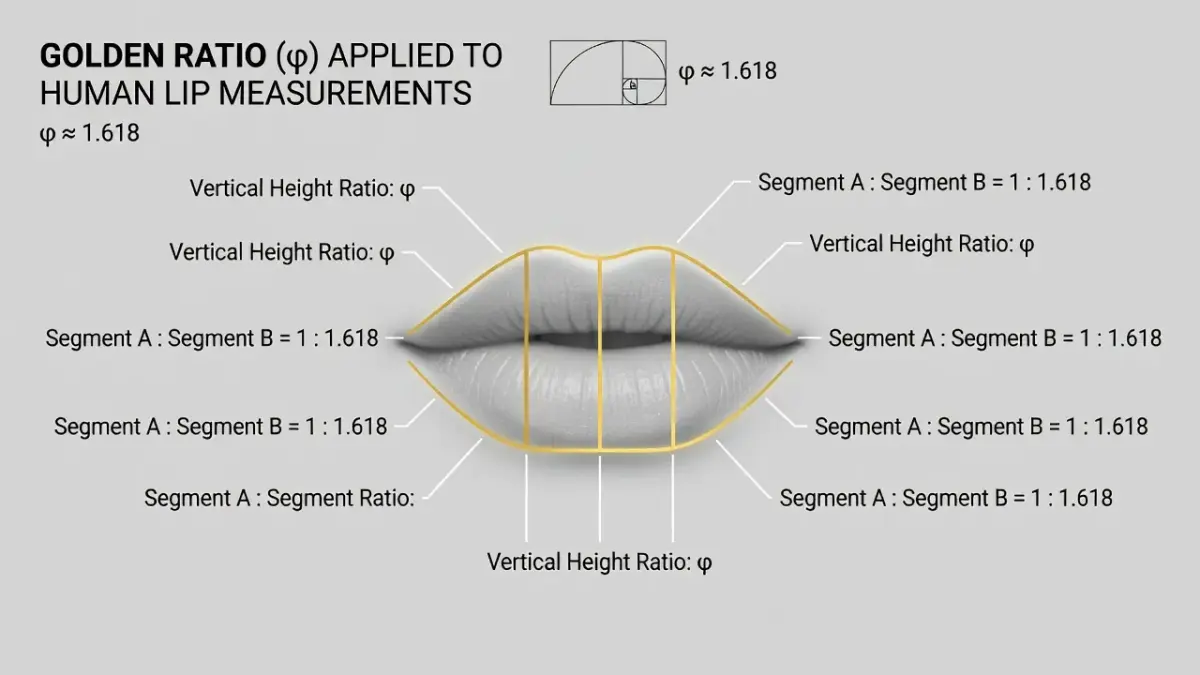
The classic aesthetic benchmark for lip proportions is based on the Golden Ratio, where the vertical height of the upper lip relates to the lower lip at a ratio of approximately 1 to 1.618.
While classical art and plastic surgery references frequently cite this ratio, modern dermatological standards acknowledge significant cultural variation in what is considered ideal. In many contemporary aesthetic frameworks, a 1:1 volume ratio between top and bottom lips has become equally popular.
Beyond the upper-to-lower lip balance, two key measurements dictate how your mouth fits into your overall face:
- Philtrum-to-Chin Ratio: The distance from the base of the nose to the upper lip border should ideally measure roughly half the distance from the lower lip border to the tip of the chin (a 1:2 ratio).
- Interpupillary Alignment: The outer corners of resting lips should line up vertically with the inner edges of your irises when looking straight ahead.
If you are interested in exploring how mathematical ratios apply across your entire facial structure, examining the principles of facial symmetry mapping offers broader context on how digital tools evaluate balance.
How to prepare your photo for an accurate AI lip scan
To get an accurate result from an AI lip shape detector, you must take a front-facing photo in neutral lighting with zero makeup and a relaxed facial expression. Algorithmic landmark tracking is highly sensitive to shadows and optical distortions.
Follow these practical guidelines before scanning your face:
- Eliminate Glare and Shadows: Stand facing a natural window. Direct overhead lights create harsh shadows under your nose that can misguide the software into misidentifying your upper lip border.
- Maintain a Neutral Expression: Smiling, smirking, or slightly opening your mouth stretches the vermilion tissue and distorts your natural width-to-height ratio.
- Keep the Camera at Eye Level: Holding your phone too low artificially lengthens your philtrum, while a high camera angle compresses your lower face dimensions.
- Wipe Off Lip Products: Gloss, dark liners, or reflective balms bounce light into the camera lens, causing computer vision engines to misread your true vermilion boundaries.
By keeping these camera conditions consistent, you ensure that the AI measures your actual facial structure rather than photo artifacts.
Frequently Asked Questions
What is the most common lip shape?
The most common lip shape globally is the balanced or naturally full lower lip shape. Studies in facial aesthetics show that a slightly fuller bottom lip relative to the upper lip occurs most frequently across diverse demographics and is widely considered a baseline proportional standard.
Can an AI lip shape detector tell if you have had lip fillers?
No, AI lip shape detectors generally cannot distinguish between natural lip tissue and dermal fillers. The algorithms measure surface geometry, boundary coordinates, and volume ratios. They evaluate the visual contour of your lips regardless of whether that shape is genetic or cosmetic.
Why do different apps give me different lip shape results?
Different apps give varying results because each developer uses proprietary training datasets, facial meshes, and landmark definitions. One app might place landmark points directly on the outer vermilion edge, while another places them slightly inside, altering the calculated width and height ratios.
Does camera distance change your detected lip shape?
Yes, camera distance significantly alters your detected lip shape due to focal length lens distortion. Taking a selfie from less than two feet away expands central facial features - making your nose and lips appear wider and rounder - compared to a photo taken from six feet away with a zoom lens.
How accurate are free online lip shape analyzers?
Free online lip shape analyzers are generally 80% to 90% accurate at identifying primary shape categories, provided the lighting and photo angle are ideal. However, basic 2D web tools struggle with depth perception and may misclassify lips if shadows blur the Cupid's bow or mouth corners.
Can lip shape change naturally over time?
Yes, lip shape changes naturally over time as collagen production decreases and facial fat pads deflate with age. This process causes the lips to lose vertical volume, thins the vermilion border, and lengthens the distance between the base of the nose and the top lip.
What is the difference between 2D and 3D lip detection?
2D lip detection analyzes flat pixel arrangements from a standard photograph, whereas 3D lip detection uses depth sensors or multi-angle mesh reconstruction to measure volume and outward projection. 3D analysis is significantly more accurate for calculating actual lip fullness.