
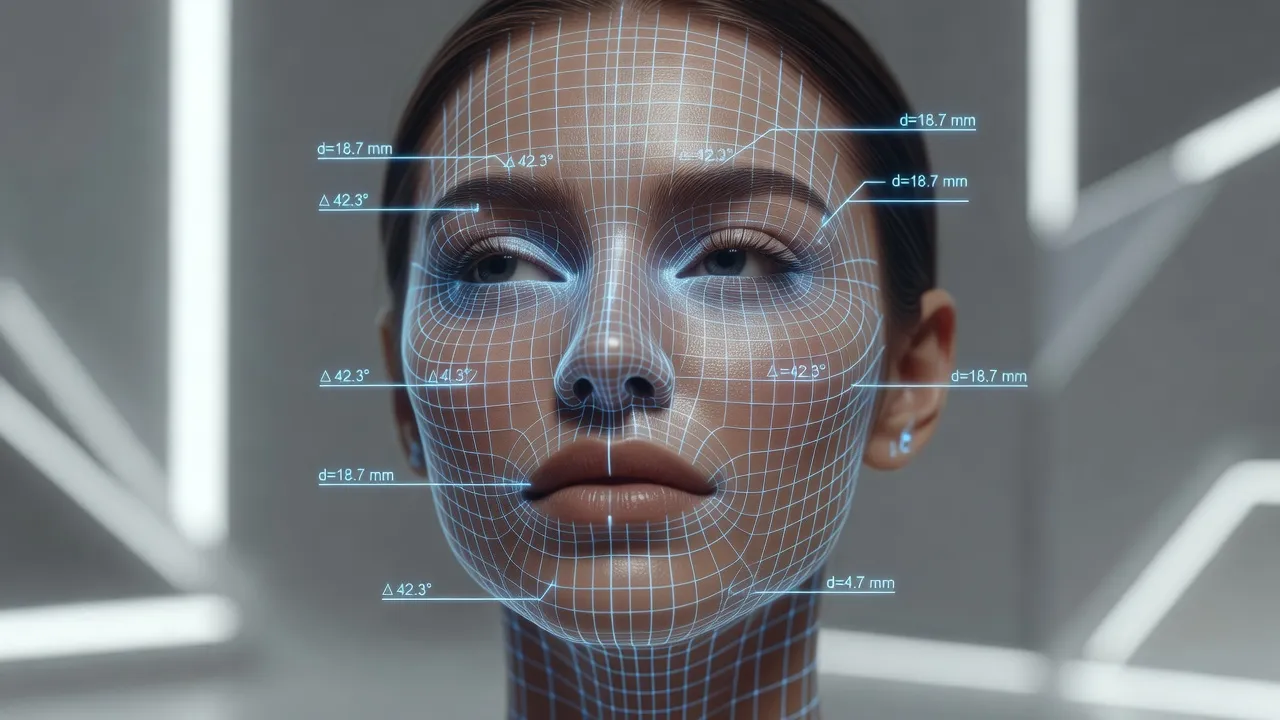
An analysis of face is the algorithmic or optical measurement of facial geometry, bone structure proportions, skin metrics, and symmetry using computer vision tools or manual mapping grids. Unlike standard photo filters, modern facial analysis breaks down landmark coordinates across your jawline, forehead, cheekbones, and eyes to identify structural traits scientifically. Whether you want to discover your exact face shape, measure structural symmetry, or evaluate skin condition, automated analysis replaces guesswork with concrete spatial data.
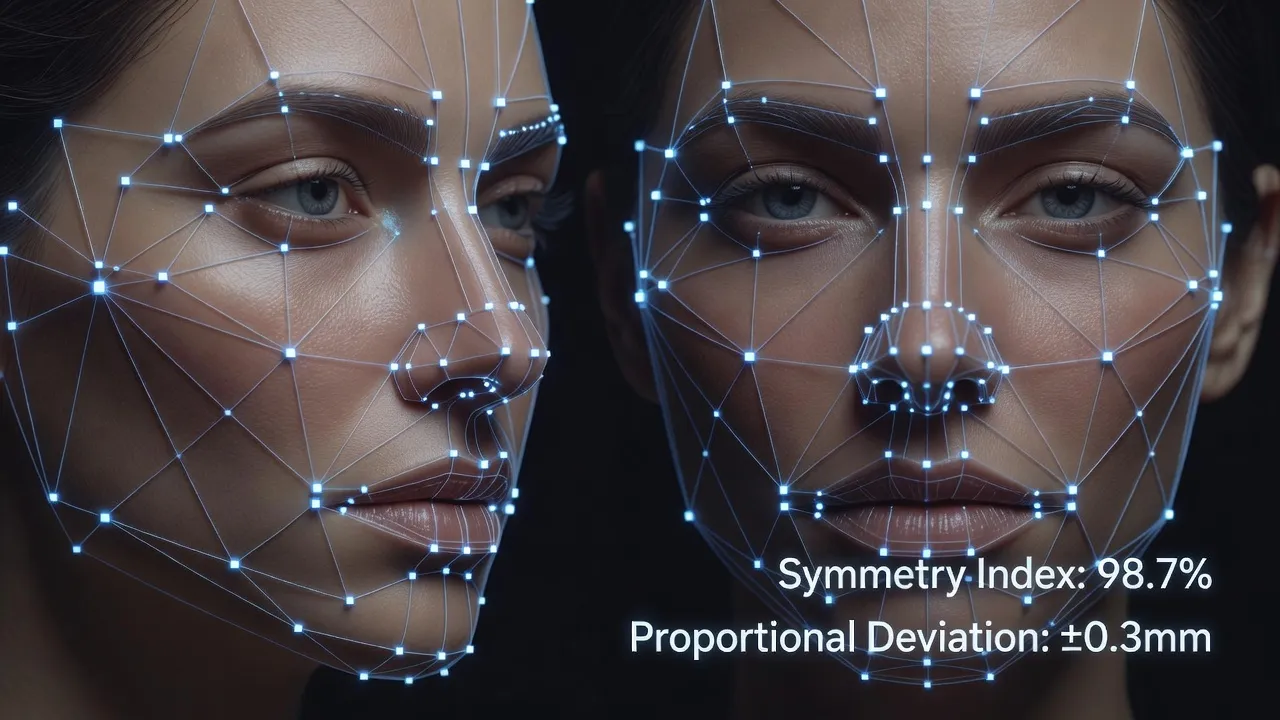
The accuracy of any facial analysis depends on one critical variable: the depth of spatial landmark mapping your software uses. A basic 2D consumer app reads roughly 68 landmark points on a static image, whereas professional spatial scanners capture thousands of three-dimensional depth points. Understanding which tool fits your goal saves you time and prevents misleading results caused by camera lens distortion.
What are the best face shape analyzer apps?
The best face shape analyzer apps use real-time facial landmark detection to measure jaw width, cheekbone distance, and forehead length before assigning a geometric classification. Most top consumer apps rely on immediate camera tracking rather than static photo uploads to eliminate perspective distortion.
- YouCam Makeup: Uses fine-tuned computer vision to map cheek-to-jaw ratios and diagnose face shape in real time.
- Glow Up & Attractiveness Test: Combines facial landmark analysis with tailored cosmetic tips and an objective attractiveness test for female facial harmony.
- Face Shape Meter: Measures distance between facial borders using manual overlay lines for custom structural proportions.
- Visada: Focuses on combined skin health, face shape geometry, and color contrast mapping.
When choosing an app, test it under neutral front-facing lighting with your hair pulled back. Shadows around the jawline distort boundary readings and often cause circular faces to scan as oval or square.
How does ModiFace's face analysis tool work?
ModiFace's face analysis tool works by running proprietary augmented reality software that detects facial landmarks and simulates skin surface light diffusion in real time. Acquired by L'Oréal, the technology maps individual facial features across video frames to analyze undertones, skin textures, and facial contour angles.
The core technology uses deep learning models trained on millions of standardized clinical images. When a camera frame loads, ModiFace aligns facial vectors to isolate key regions like the eye contours, cheeks, and lips. This allows the system to evaluate skin hyperpigmentation or project realistic cosmetic products directly onto moving 3D facial topography.
Enterprise cosmetic brands embed ModiFace SDKs into mobile apps and web platforms. According to L'Oréal's technical release notes, the framework processes video input directly on device processors to maintain frame rates above 30 frames per second without latency.
How does YouCam Makeup's (Perfect Corp) face analysis work?
YouCam Makeup uses Perfect Corp's AgileFace AI technology to track up to 200 facial landmarks in real time for structural and skin condition analysis. The engine processes facial topography to grade wrinkles, dark circles, redness, and spot density while simultaneously identifying jaw and cheek proportions.
- Video Input
- 200-Point Mesh Mapping
- Feature Zoning
- Diagnostic Output: Face Shape + Skin Metrics + Structural Ratios
Steps 1 through 3 feed sequentially into step 4.
The system separates structural assessment from skin surface analysis. First, the mesh identifies structural borders to classify your frame into one of seven standard face shapes. Second, high-resolution texture maps evaluate dermal light reflection to produce detailed skin health scores across targeted facial zones.
As reported on Perfect Corp's developer documentation, their skin analysis AI evaluates sub-surface features across multiple illumination levels. This multi-zone diagnostic gives users a free face analysis breakdown directly inside the browser or mobile application.
Are there apps that analyze facial features and symmetry?
Yes, specialized facial feature apps measure structural symmetry by calculating horizontal and vertical alignment ratios between paired features like eyebrows, eyes, and jaw corners. These applications divide the face down the central midline to highlight natural lateral discrepancies in bone structure and muscle tone.
True facial symmetry is extremely rare, with over 95% of human faces exhibiting measurable left-right variations. High-precision apps calculate your symmetry score by projecting a geometric grid over your pupil centers, nose bridge, and lip corners.
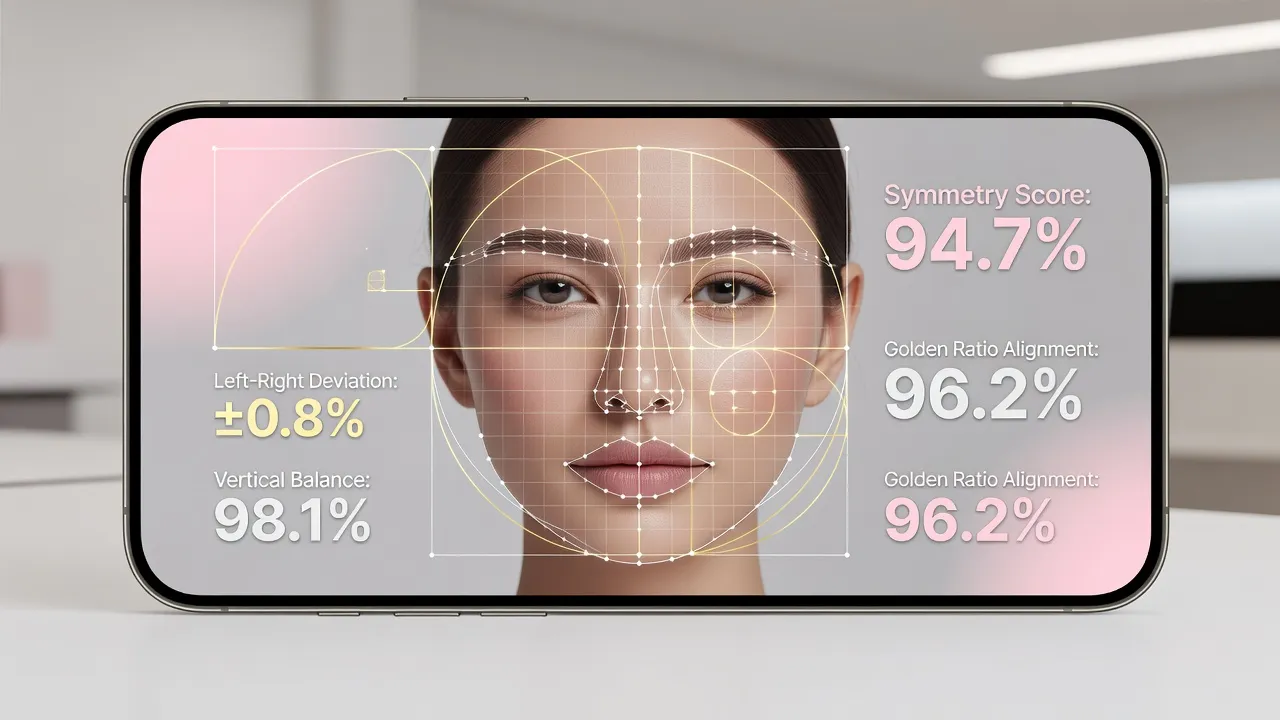
For female aesthetic evaluation, tracking feature placement against traditional proportions helps inform beauty decisions like brow shaping or contouring. Apps that include a face scanner rating evaluate how closely feature spacing mirrors established aesthetic standards.
Are Face++, OpenFace, or Google Vision used for academic face analysis?
Yes, Face++, OpenFace, and Google Vision API are widely used by academic researchers and software engineers to conduct automated facial measurement, emotion recognition, and structural analysis. These platforms provide underlying developer tools rather than simple consumer interfaces.
- OpenFace: An open-source facial behavior analysis toolkit capable of facial landmark detection, head pose estimation, and eye gaze tracking. Researchers host the source code publicly on the OpenFace GitHub repository.
- Face++: A commercial cognitive service API by Megvii that delivers 106-point or 1057-point dense facial landmark extraction for precise geometric mapping.
- Google Vision API: Google's cloud vision framework that detects facial presence, landmark coordinates, and emotional likelihood metrics. Technical specifications are documented on the Google Cloud Vision API page.
Academic institutions leverage these tools because they output raw numerical vectors, coordinate arrays, and landmark datasets. Instead of returning vague descriptions, these frameworks deliver raw pixel coordinates ready for statistical modeling and peer-reviewed research.
Is Bellus3D reliable for face shape analysis?
Bellus3D was exceptionally reliable for 3D face shape analysis using iPhone TrueDepth sensors, but the company officially ceased consumer operations and app availability in 2022. While the software is no longer supported on consumer app stores, its methodology set the industry benchmark for mobile 3D face scanning.
Bellus3D utilized infra-red projection to capture over 50,000 depth points across the human face. This produced a true millimeter-accurate 3D mesh that completely eliminated camera lens distortion—the biggest flaw in standard 2D photos.
Today, professional clinics and advanced mobile apps utilize similar infrared depth sensing technologies to yield dependable face shape reports. Without 3D depth sensors, standard photos remain prone to focal length distortion that alters perceived cheekbone width and chin sharpess.
Understanding Facial Features and Proportions
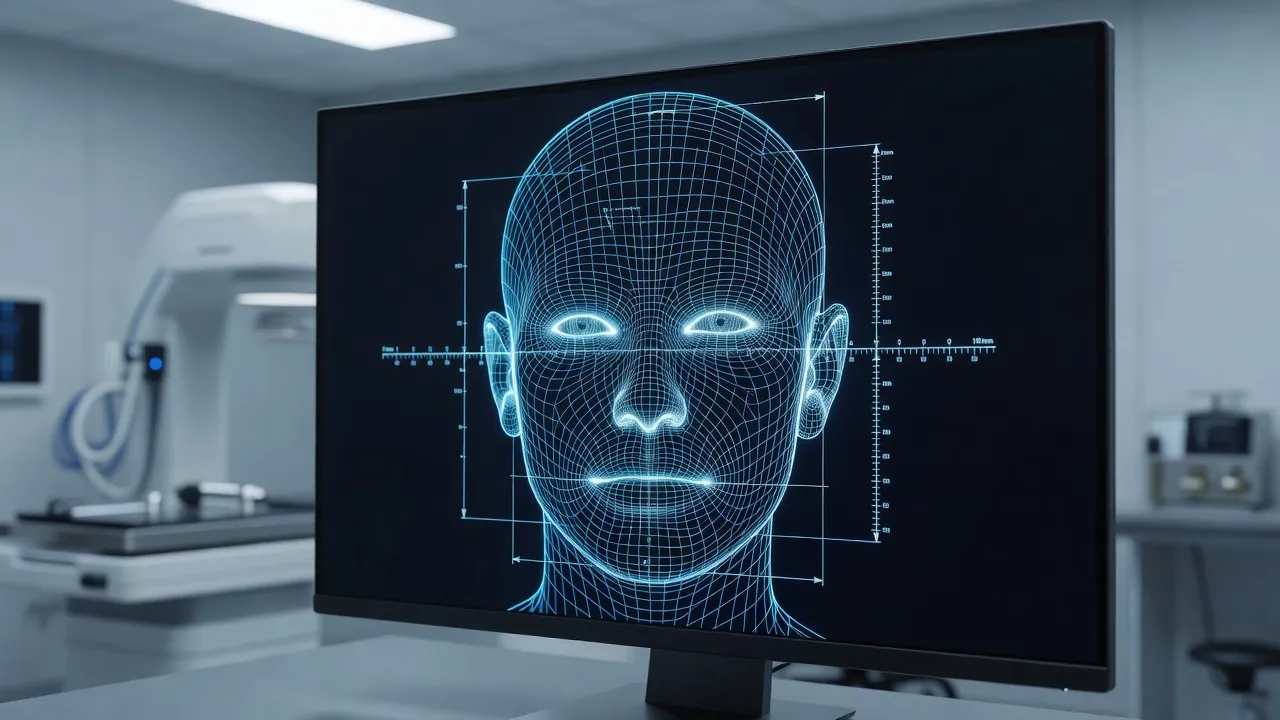
Facial proportion analysis evaluates how individual features scale against one another using classical aesthetic frameworks like facial thirds and facial fifths. These classical rules divide the face vertically and horizontally to assess balance and alignment.
The vertical rule of thirds divides your face into three equal zones: from the hairline to the brow line, the brow line to the base of the nose, and the nose base to the bottom of the chin. If one section is noticeably longer or shorter, it changes how your overall shape is perceived.
| Zone | Boundaries | Vertical Distance |
|---|---|---|
| Zone 1 | Hairline to Eyebrows | Equal |
| Zone 2 | Eyebrows to Nose Base | Equal |
| Zone 3 | Nose Base to Chin Tip | Equal |
Horizontal balance relies on facial fifths, where the total width of your face equals five times the width of one eye. Understanding these spatial ratios allows you to select complimentary styling options, such as tailored haircuts based on face shape that balance dominant angles.
How AI-Based Facial Analysis Software Works
Modern AI face analysis software runs convolutional neural networks trained on millions of annotated face images to locate facial landmarks automatically. When you upload a photo, the algorithm converts pixels into a spatial coordinate map.
- Face Detection: The algorithm scans the image frame to isolate human facial boundaries from background noise.
- Landmark Extraction: Key anchor points are identified around the eyes, eyebrows, nose bridge, lips, and jawline.
- Geometric Calculation: The software measures distances, vector angles, and surface area ratios between landmarks.
- Classification Output: Data is compared against trained models to generate a full face analysis report detailing face shape, symmetry metrics, and feature proportions.
Traditional computer vision frameworks relied on 68 basic landmarks, but advanced neural networks now extract dense 468-point 3D facial meshes. This allows AI systems to analyze fine contours, soft-tissue volume, and minute asymmetries that human eyes miss.
Comparing Commercial and Academic Face Analysis Tools
Selecting the right face analysis software depends entirely on whether you need quick cosmetic feedback or quantitative research metrics. Consumer applications offer user-friendly diagnostic scores, whereas developer APIs provide raw geometric datasets.
The table below contrasts leading face analysis tools based on feature capacity, ideal use cases, and data depth as of August 2026.
| Tool / Platform | Target Audience | Primary Focus & Strengths | Landmark Mesh Depth | Output Type |
|---|---|---|---|---|
| ModiFace | Enterprise Brands | Real-time AR makeup try-on and skin light diffusion tracking | ~100 dynamic points | Visual AR overlays & diagnostic scores |
| OpenFace | Academic Researchers | Open-source action unit detection, eye gaze, and head pose vectoring | 68 2D/3D landmarks | Raw CSV coordinates & Action Unit data |
| Glow Up & Attractiveness Test | Female Consumer Beauty | AI face shape ratings, glow up guides, and personalized beauty recommendations | Fine-tuned 3D mesh model | Comprehensive face analysis report & scores |
| Face++ (Megvii) | Enterprise & Developers | High-speed commercial landmark extraction and facial verification | 106 to 1057 dense points | JSON coordinate payloads |
| YouCam Makeup (Perfect Corp) | Consumer & Retail | Multi-zone skin texture diagnostic and virtual cosmetic mapping | ~200 real-time points | Visual skin health scores & AR product simulation |
When comparing these options, consumer-focused options prioritize actionable aesthetic advice, while API engines focus purely on dataset extraction. For personal beauty tracking, consumer tools strip away complex code and present structural facts in clear, practical terms.
Analyzing Female Facial Aesthetics with Glow Up & Attractiveness Test
If your main goal is evaluating personal appearance, the Glow Up & Attractiveness Test offers a tailored iOS experience designed specifically for female face shape analysis. While enterprise developer APIs output unformatted coordinate lists, this app converts facial geometry into practical style adjustments.
To generate a complete face analysis test score, download the app on your iPhone via the iOS App Store page and capture a front-facing photo in neutral lighting. The app processes your facial features using an AI model fine-tuned on female cosmetic proportions.
The software evaluates your face shape, feature spacing, and structural balance, then provides tailored tips to elevate your look. Instead of leaving you with abstract numbers, it outlines actionable steps—from brow shaping recommendations to custom makeup mapping—so you can systematically reach your aesthetic goals.
Free Face Analysis vs. Paid Face Analysis Reports
Free face analysis tools deliver quick basic shape classifications and surface metrics, whereas paid reports offer deep volumetric mapping and personalized beauty plans. The right choice depends on whether you want a quick instant answer or an actionable step-by-step beauty strategy.
Free basic tools typically rely on web-based 2D landmark detection. They work well for identifying whether your face is round, oval, heart, or square. However, free tools rarely account for lighting flaws or focal length distortions that warp feature distances.
Comprehensive paid analysis platforms utilize fine-tuned neural networks to generate an exhaustive face analysis report. These reports evaluate micro-symmetry, calculate exact facial proportion ratios, and supply personalized glow-up routines. I think paying for a detailed analysis makes sense if you plan to change your hairstyle, start a targeted beauty routine, or update your makeup strategy based on accurate structural facts.
Frequently Asked Questions
Can a phone camera accurately analyze my face shape?
Yes, a phone camera can analyze your face shape if you take the photo from at least three feet away using flat, natural lighting. Holding the camera closer than three feet creates wide-angle lens distortion that unnaturally enlarges your nose and shrinks cheekbone width.
What is the ideal focal length for taking a face analysis photo?
A focal length between 85mm and 105mm is ideal for face analysis photos because it renders facial features without geometric distortion. Standard smartphone wide-angle front cameras distort peripheral cheekbone boundaries, so using a telephoto lens or stepping back and zooming in produces much more reliable measurements.
How do I prepare my face for an AI face analysis test?
To prepare for an AI face analysis test, remove all makeup, pull your hair completely back away from your forehead and ears, and sit directly facing a light source. Ensure there are no harsh side shadows across your jawline or under your nose that could trip up optical landmark edge detection.
What is the difference between 2D and 3D face analysis?
A 2D face analysis measures flat pixel coordinates on a static image, making it vulnerable to camera angles and lighting shadows. A 3D face analysis captures depth geometry using infrared sensors or multi-angle mesh processing, yielding millimeter-accurate spatial measurements of your true bone structure.
Why do different face shape apps give me different results?
Different face shape apps give varied results because each algorithm uses different landmark thresholds, aspect ratio mathematical cutoffs, and lens distortion adjustments. Additionally, subtle changes in head tilt, camera angle, and overhead room lighting between scans alter edge detection readings.
How does facial symmetry impact attractiveness scores?
Facial symmetry impacts perceived visual harmony because human brains process symmetrical patterns with less cognitive effort. However, mild asymmetry is entirely normal, and individual feature proportions like eye size, jaw definition, and lip shape play an equally critical role in total facial attractiveness.
Are free face analysis online tools safe for privacy?
Free face analysis online tools are safe if the provider clearly states in their privacy policy that images are processed locally on-device or deleted immediately after generating your report. Avoid using tools that reserve rights to store, license, or sell your biometric facial data to third-party ad networks.
Can an AI face shape analyzer suggest better haircuts?
Yes, an AI face shape analyzer can suggest better haircuts by calculating your forehead-to-jaw ratio and identifying your vertical facial thirds. Once your primary face frame is established, the software matches your structural geometry with hair lengths and layers that balance prominent angles.