
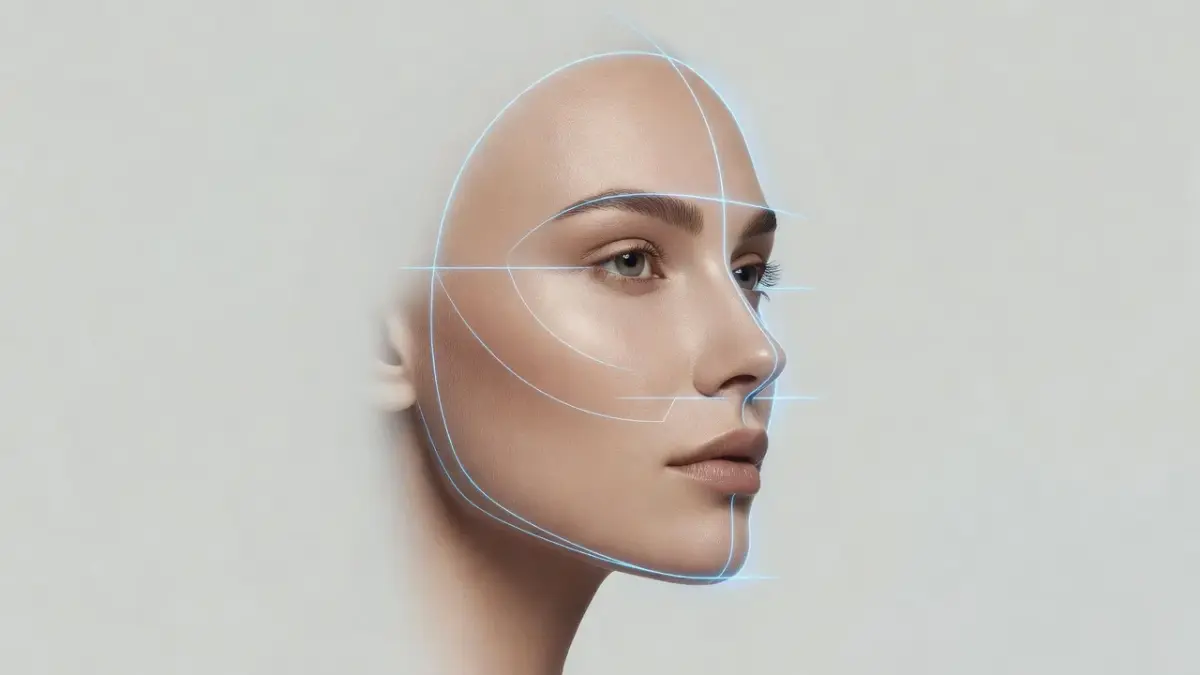
Face patterns are recurring geometric relationships between facial landmarks, including bone contours, facial proportions, and symmetry markers. These mathematical arrangements dictate face shape classification, perceived visual balance, and anatomical harmony. Rather than focusing on single features in isolation, analyzing face patterns evaluates how the forehead, cheekbones, jawline, and vertical thirds interact as a cohesive structural network.
Understanding your unique face structure helps optimize hairstyles, contouring, and aesthetic choices. Whether using manual measurements or an AI analysis app like Glow Up & Attractiveness Test, decoding these anatomical arrangements reveals the underlying blueprint of your appearance.
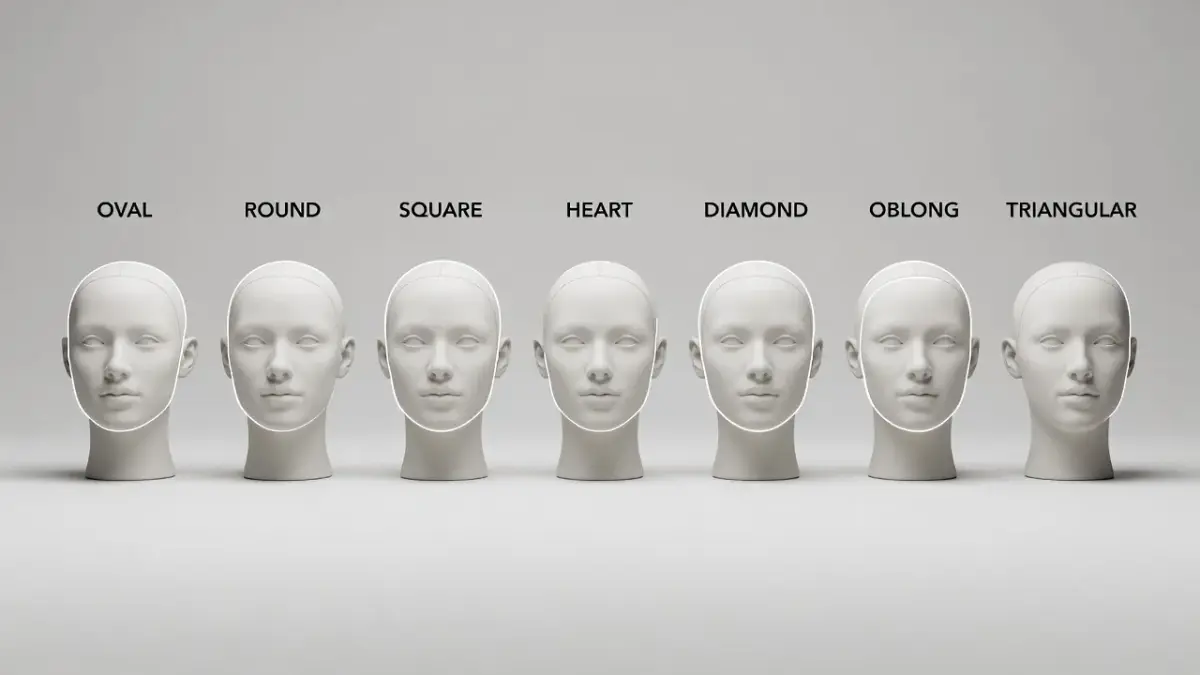
What are the common face shape categories: oval, round, square, heart, diamond, oblong, triangular?
The seven primary face shape categories are defined by the specific ratio of facial length to width combined with the structural prominence of the jaw, forehead, and cheekbones. Each shape creates a distinct silhouette based on where the widest facial plane sits.
Three shapes are drawn side by side, left to right: Oval, Round, Square.
- Oval: Widest at Cheeks
- Round: Equal Height/Wd
- Square: Sharp Jaw
- Oval: The facial length is roughly 1.5 times the width, with cheekbones forming the widest line. The jawline and forehead are gently rounded without sharp angles.
- Round: The facial width and length are virtually equal. Cheekbones represent the widest point, paired with a soft, rounded jawline and full cheeks.
- Square: The forehead, cheekbones, and jawline share almost identical widths. The jawline is sharp, broad, and angular.
- Heart: The forehead or temple area is noticeably wider than the jawline. The face tapers down to a sharp, pointed chin.
- Diamond: Cheekbones are high and prominent, forming the widest zone. Both the forehead and jawline are narrow and symmetrical.
- Oblong: The face is noticeably longer than it is wide, maintaining a straight, uniform side profile from temples to jaw.
- Triangular: The jawline is the widest feature, while the forehead narrows toward the hairline.
To identify your category accurately, you can measure three key width spans: temple to temple, cheekbone to cheekbone, and jaw-corner to jaw-corner. Comparing these against your overall facial height identifies your primary pattern. If you want to check your exact shape quickly, read our detailed guide on face shapes analysis for step-by-step measuring steps.
| Face Pattern Category | Widest Point | Jawline Geometry | Facial Length vs. Width | Key Architectural Trait |
|---|---|---|---|---|
| Oval | Cheekbones | Softly curved | Length is ~1.5x width | Balanced, classic proportions |
| Round | Cheekbones | Full, circular | Length equals width | Soft contours without sharp angles |
| Square | Equal throughout | Broad, 90-degree angles | Length equals width | Strong, angular bone structure |
| Heart | Forehead | Tapered, pointed chin | Length slightly exceeds width | Wide upper third, narrow lower third |
| Diamond | High cheekbones | Narrow, pointed chin | Length exceeds width | Sharp cheek projection, thin forehead |
| Oblong | Equal throughout | Square or slightly rounded | Length is >1.5x width | Vertical elongation with parallel sides |
| Triangular | Jawline | Wide, heavy base | Length exceeds width | Broad lower third tapering upward |
What do facial proportions, the golden ratio and neoclassical canons mean in face analysis?
Facial proportions, neoclassical canons, and the golden ratio are geometric frameworks used to evaluate spatial harmony and feature placement across the face. These guidelines allow aesthetic researchers and clinicians to measure how features relate to one another numerically.
A classic benchmark in anatomical analysis is the set of Neoclassical Canons. Established by Renaissance artists and later adapted by reconstructive surgeons, these rules break the face into equal sections:
- The Vertical Thirds Canon: Divide the face from the hairline to the chin into three equal segments: upper (hairline to glabella), middle (glabella to subnasale), and lower (subnasale to menton).
- The Horizontal Fifths Canon: Divide the face horizontally into five equal widths, each matching the width of one eye.
Three segments are stacked vertically, from top to bottom:
- Upper Third (Hairline to Brows)
- Middle Third (Brows to Base of Nose)
- Lower Third (Base of Nose to Chin)
Another widespread metric is the Golden Ratio (Phi), approximately 1.618. In face analysis, researchers evaluate whether key distances (such as total face length divided by cheekbone width) align with this ratio. According to biological research on facial symmetry on Wikipedia, minor variations from these mathematical ideals are completely normal across populations.
For a deeper look into spatial measurements, check our breakdown of face proportions to calculate your own ratios.
How AI models analyze facial patterns for modern aesthetics
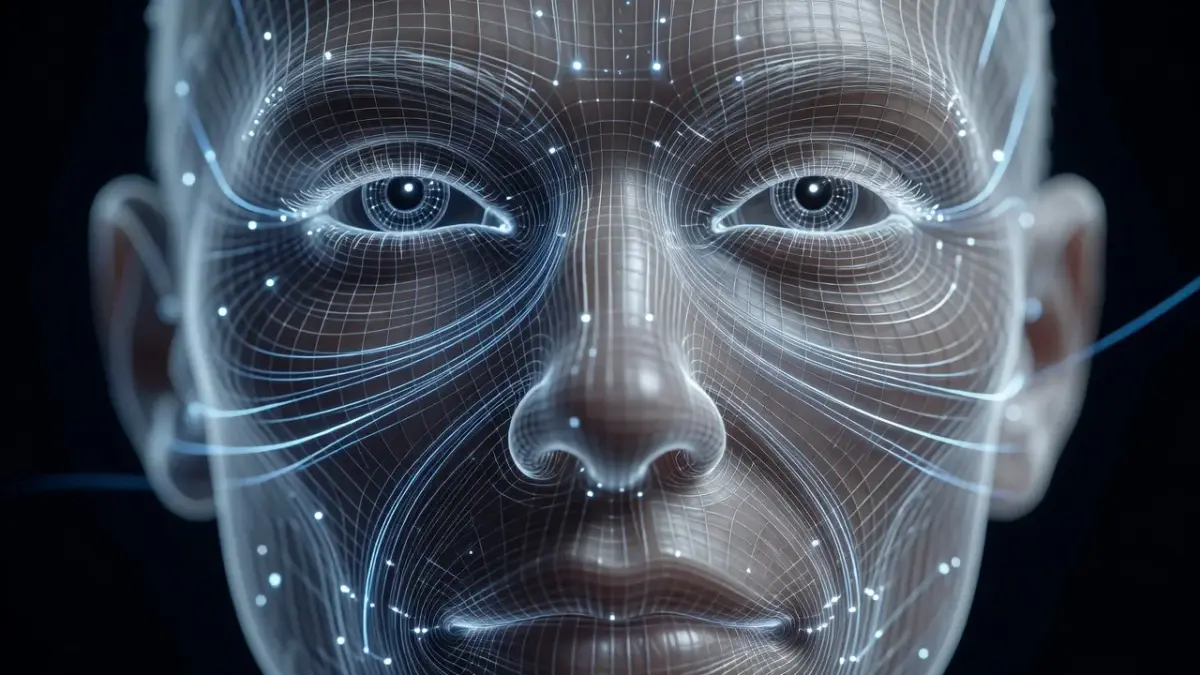
Modern AI face analysis models read facial patterns by mapping hundreds of coordinate points across a 3D digital mesh to calculate symmetry and geometry. Rather than guessing shape visually, algorithms process exact pixel coordinates to detect subtle spatial relationships.
As of November 2026, machine vision systems rely on developer tools like Google MediaPipe's Face Landmarker to pin 468 3D landmark coordinates onto a single face image. These points measure distances between the pupil center, nostril edges, lip peaks, and jaw angles in real time.
For women looking to decode their facial structure without manual tape measures, dedicated consumer applications automate this process. Using the Glow Up & Attractiveness Test app, you can upload a plain selfie to receive an instant analysis powered by fine-tuned AI models. Available for $9.99/week, the app generates a personalized face rating score, breaks down structural harmony, and offers tailored beauty tips to highlight your best features.
Pricing parameters verified in November 2026 show distinct operational differences between manual analysis, mirror mapping, and dedicated software:
| Analysis Method | Best Reader Fit | Measurement Accuracy | Time Required | Primary Output |
|---|---|---|---|---|
| Manual Caliper Mapping | Clinical practitioners & surgeons | High (mm precision) | 20-30 minutes | Raw physical dimensions |
| Glow Up & Attractiveness Test | Women optimizing daily aesthetics | High (AI facial mesh) | < 1 minute | Instant beauty score & glow up guide |
| Golden Ratio Plastic Stencils | Makeup artists & eyebrow tech staff | Moderate (Subjective) | 5-10 minutes | Visual alignment overlay |
| Basic Mirror Estimation | Quick casual checks | Low (Visual bias) | Instant | General shape estimate |
I'd skip manual caliper tracking unless you are undergoing specialized orthodontic or cosmetic procedures. For daily style decisions, automated computer vision offers far more consistent feedback.
Which face shape makeup and hair recommendations suit heart-shaped, oval and square faces?
Makeup and hair recommendations for heart, oval, and square faces focus on strategically adding volume or shadow to balance out specific geometric proportions. The objective is to create visual equilibrium across the upper, middle, and lower thirds.
Heart-Shaped Face Patterns
Heart shapes feature a broader upper third and a narrow chin.
- Haircut Strategy: Opt for chin-length bobs, long side-swept bangs, or curtain bangs that create width around the narrow jawline. Avoid extreme top volume that exaggerates forehead width.
- Makeup Application: Apply contour to the sides of the forehead and temples to reduce perceived width. Highlight the center of the chin to soften its point.
Oval Face Patterns
Oval faces are structurally balanced, making them adaptable to most styles.
- Haircut Strategy: Most styles work well, including blunt bobs, shoulder-length layers, and swept-back cuts. Avoid heavy straight-across bangs that shorten the face excessively.
- Makeup Application: Focus on enhancing natural symmetry rather than correcting proportions. Apply blush directly to the apples of the cheeks and sweep upward toward the temples.
Square Face Patterns
Square faces carry equal width across the forehead and jaw, anchored by strong angles.
- Haircut Strategy: Soft, layered cuts, shoulder-length waves, and off-center parts help break up rigid lateral lines. Avoid sharp, chin-length blunt cuts that emphasize jaw squareness.
- Makeup Application: Contour the four outer corners of the face - the upper temples and the outer jaw angles. Apply highlighter to the center of the forehead and chin to pull attention inward.
If you are evaluating automated tools to help match styling choices to your facial geometry, check our comparison of the best AI face rating apps.
How facial symmetry influences human pattern recognition
Human visual processing naturally favors facial symmetry because the brain interprets bilateral balance as a subconscious marker of health and physical development. When looking at a face, the visual cortex processes left-to-right alignment in milliseconds.
In biological research published by the National Center for Biotechnology Information, scientists note that perfect symmetry rarely exists in natural human faces. Instead, slight variation - known as fluctuating asymmetry - is standard.
The drawing shows two faces side by side. The High Symmetry face is on the left, and the Natural Asymmetry face is on the right. Only the Natural Asymmetry face carries notes, and each note points to a feature on that face.
- Slightly higher eye: pointed to the upper line of the Natural Asymmetry face
- Minor lip slant: pointed to the lower line of the Natural Asymmetry face
Common factors contributing to asymmetrical face patterns include:
- Chewing Dominance: Habitually chewing food on one side builds greater masseter muscle volume on that side.
- Sleep Posture: Sleeping on one side for years puts physical pressure on facial bones and soft tissue.
- Dental Alignment: Uneven bite mechanics or missing teeth alter jaw position over time.
Small asymmetries often give a face character rather than detracting from it. Using targeted makeup application or parting your hair strategically can easily rebalance asymmetrical patterns without invasive procedures.
To monitor your facial symmetry trends and test new looks over time, try taking a selfie on the Glow Up & Attractiveness Test app to track your aesthetic score and build confidence.
Frequently Asked Questions
What is the rarest face pattern category?
The diamond face shape is widely considered the rarest category because it requires a specific combination of prominent high cheekbones alongside a narrow forehead and jawline.
Can your face pattern shape change naturally over time?
Yes, facial patterns shift due to bone density changes, fat redistribution, muscle development, and the natural aging process. Weight changes and masseter muscle hypertrophy can also broaden the lower jaw outline.
How do I know if my face pattern is oval or round?
Measure your facial length from hairline to chin and width across your cheekbones. An oval face has a length significantly greater than its width, whereas a round face features nearly equal length and width dimensions.
Does facial symmetry guarantee higher attractiveness scores?
While symmetry increases visual harmony, overall attractiveness relies equally on skin clarity, feature size proportions, neoclassic ratio alignments, and cheekbone definition.
Why do cameras make face patterns look different than mirrors?
Camera lenses cause focal length distortion, particularly when taken close up as a selfie. Short focal lengths compress facial depth and enlarge central features like the nose compared to a flat mirror reflection.
Can face exercises alter bone structure patterns?
Face exercises target superficial facial muscles rather than underlying jaw bones. While masseter exercises can build jaw muscle volume, they do not reshape skeletal facial architecture.
What face shape is considered the most balanced mathematically?
The oval face pattern is traditionally considered the most balanced because its vertical and horizontal dimensions align naturally with classic aesthetic canons without extreme angles.