

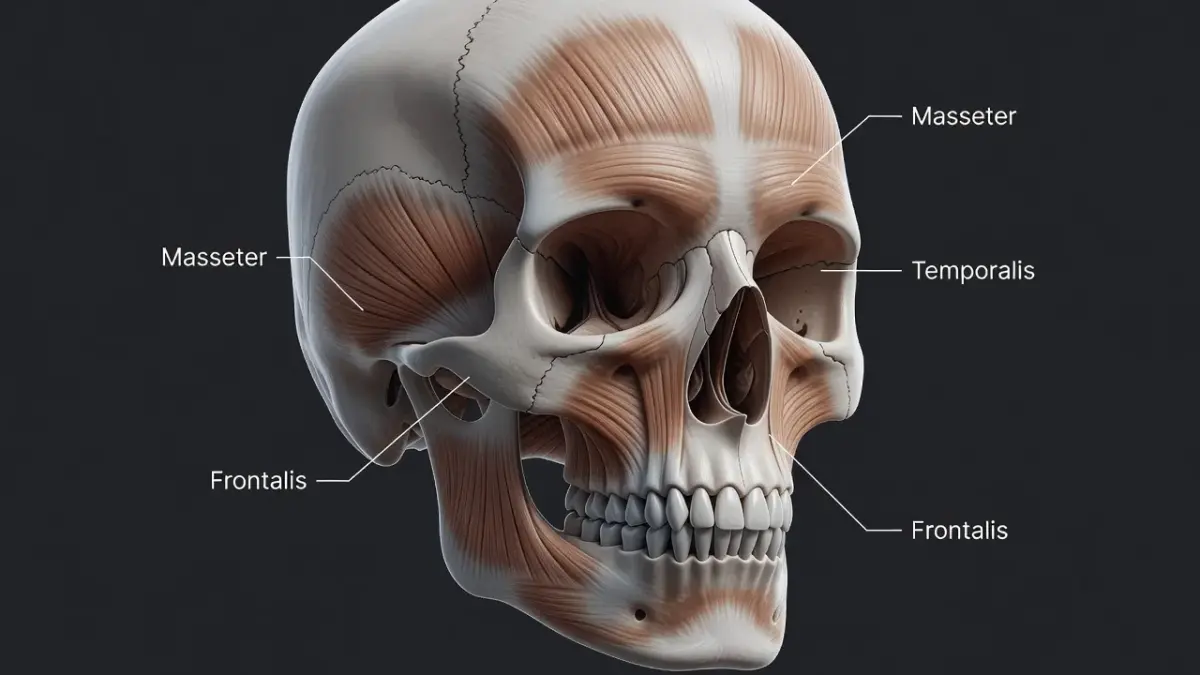
Tight face muscles occur when hypertonic facial musculature - most commonly the masseter, temporalis, or frontalis muscles - remains continuously contracted due to jaw clenching, stress, temporomandibular joint dysfunction, or underlying neurological conditions. This persistent contraction restricts blood flow, causes localized stiffness, and frequently radiates pain into the jaw, temples, and neck. If chronic tension starts affecting your facial balance or jawline symmetry, tracking your facial proportions with our iPhone app, Glow Up & Attractiveness Test, provides objective AI-powered face analysis and personalized structural scores.
Four items are stacked from top to bottom, each linked to the one below it:
- FRONTALIS (Forehead Tension)
- TEMPORALIS (Temple Headaches)
- MASSETER (Jaw & Bruxism Tight)
- PTERYGOIDS (TMJ & Deep Tension)
What causes facial muscle tightness and facial tension?
Facial muscle tightness is primarily caused by involuntary muscle overuse, mechanical joint imbalance, acute emotional stress, or peripheral nerve hyperexcitability. When the facial nerve (cranial nerve VII) or trigeminal nerve (cranial nerve V) repeatedly signals target muscle groups to contract without adequate rest phases, lactic acid builds up and triggers chronic stiffness.
What are the main muscles involved in facial stiffness?
The muscles most susceptible to facial tightness are the masseter, temporalis, lateral pterygoid, and frontalis. The masseter muscle exerts up to 200 pounds of force on the molars, making it the single largest contributor to lower face tightness. The temporalis covers the sides of the skull and triggers temple headache pressure, while frontalis strain creates continuous forehead rigidity.
Can sinus infections or dental issues feel like tight face muscles?
Yes, acute sinus congestion and dental infections frequently cause referred facial muscle tightness. Inflammation in the maxillary sinuses creates pressure behind the cheekbones, which prompts neighboring muscles to spasm defensively. Likewise, an improper dental bite (malocclusion) forces facial muscles to work unevenly to close your jaw, driving asymmetrical muscular fatigue.
Can bruxism and TMJ disorders cause tight jaw and facial muscles?
Yes, bruxism and temporomandibular joint (TMJ) disorders are among the leading causes of chronic tightness in the jaw and surrounding facial muscles. Nocturnal tooth grinding (sleep bruxism) forces the masseter and temporalis muscles into sustained isometric contractions for hours, preventing normal nocturnal muscle recovery.
How does TMJ dysfunction trigger muscle spasms across the face?
TMJ dysfunction alters normal jaw biomechanics, causing surrounding muscles to spasm in an attempt to stabilize the unstable joint. According to clinical guides from the National Institute of Dental and Craniofacial Research, temporomandibular disorders affect millions of adults, frequently presenting as joint clicking, restricted mouth opening, and intense muscle strain. When the articular disc inside the jaw joint shifts out of position, the lateral pterygoid muscle stays permanently contracted to compensate.
What are the main signs that tight face muscles stem from bruxism?
The hallmark symptoms of bruxism-induced muscle tightness include waking up with a sore jaw, flattened molar teeth, and radiating morning temple headaches. You may also notice visible hypertrophy (bulking) of your lower jaw muscles over time. If muscle imbalances begin altering your facial symmetry, comparing your features against our strong face muscles guide can help you identify whether muscular enlargement or joint misalignment is the primary driver.
Does stress or clenching cause tight face muscles?
Yes, emotional stress directly triggers facial tightness by activating the sympathetic nervous system and causing subconscious jaw clenching, brow furrowing, and shoulder elevation. During psychological stress, the body releases cortisol and adrenaline, elevating resting muscle tone across the entire craniofacial region.
Why do people clench their jaw during daytime stress?
Daytime jaw clenching - often called diurnal bruxism - is a unconscious coping mechanism used by the brain to process focus, anxiety, or frustration. Most people remain entirely unaware that their upper and lower teeth are locked together while driving, working at a computer, or reading. Healthy resting face posture requires teeth to sit 2 to 3 millimeters apart with the tongue resting gently on the roof of the mouth.
How does emotional stress affect the upper facial muscles?
Stress forces the corrugator supercilii and frontalis muscles into fixed contractions, leading to tight brow ridges and forehead tension. This constant tension restricts local blood circulation, accelerating tension-type headaches that wrap around the forehead and temples.
| Cause of Tightness | Primary Muscles Affected | Key Symptoms | Standard Diagnostic Focus |
|---|---|---|---|
| Bruxism & TMJ | Masseter, Temporalis, Pterygoids | Morning jaw pain, tooth wear, clicking | Dental exam, bite analysis |
| Stress & Clenching | Frontalis, Corrugator, Masseter | Forehead tightness, neck stiffness, midday fatigue | Postural & stress evaluation |
| Facial Dystonia | Orbicularis oculi, Lower facial muscles | Involuntary twitching, spasms, pulling sensations | Neurological evaluation |
| Myofascial Pain Syndrome | Masseter, Trapezius, Sternocleidomastoid | Deep trigger points, referred tooth pain | Physical therapy palpation |
Can facial dystonia cause tight facial muscles?
Yes, facial dystonia is a neurological movement disorder that causes involuntary, sustained facial muscle contractions and abnormal posture. Unlike temporary stress tightness, facial dystonia originates from faulty signaling within the basal ganglia in the brain, sending incorrect nerve signals to facial muscles.
What is the difference between focal dystonia and standard tension?
Focal facial dystonia causes involuntary contractions that you cannot consciously relax, whereas standard stress tension subsides with rest and conscious effort. Conditions like blepharospasm force the eyelids to shut involuntarily, while meige syndrome involves combined muscle spasms in the eyes, lower face, and jaw.
How does hemifacial spasm differ from facial dystonia?
Hemifacial spasm affects only one side of the face due to irritation of the facial nerve, whereas dystonia usually stems from central nervous system signaling. As documented by the Mayo Clinic, hemifacial spasm is typically caused by a small blood vessel pressing against cranial nerve VII near the brainstem, leading to twitching and localized tightness on a single side.

Does myofascial release massage or physical therapy relieve tight facial muscles?
Yes, targeted myofascial release massage and physical therapy relieve facial tightness by breaking down muscular trigger points, increasing blood flow, and restoring resting tissue length. Manual therapy physically stretches hypertonic muscle fibers and stimulates lymphatic drainage to flush metabolic waste from overworked muscles.
How do soft tissue techniques release masseter tension?
Intraoral myofascial release - where a trained clinician applies pressure inside the mouth along the masseter - relieves deep jaw tightness faster than external massage alone. Pressing gently on trigger points for 30 to 60 seconds triggers an autogenic inhibition response, forcing the tight muscle spindles to relax.
What daily physical exercises soothe tight facial muscles?
Controlled jaw opening exercises and gentle neck stretches reduce resting facial tension within two to three weeks of consistent daily practice. The following routine helps reset hypertonic muscles:
- The Tongue-Up Jaw Opener: Place the tip of your tongue on the roof of your mouth behind your front teeth, then slowly open your mouth as wide as comfortable without dropping your tongue.
- Resistance Jaw Release: Place your thumb under your chin and push gently upward while opening your mouth slowly against light pressure.
- Temporal Passive Stretch: Press your palm against your temple and pull gently upward while opening your mouth to lengthen the temporalis muscle.
If chronic muscular tension has created visible structural imbalances across your jaw or cheeks, reviewing options in an asymmetrical face treatment guide provides useful pathways for balancing your features after tension resolves.
Can Botox treat facial muscle tightness from bruxism or TMJ?
Yes, Botulinum toxin (Botox) injections treat facial tightness by temporarily blocking acetylcholine release at the neuromuscular junction, preventing overactive muscles from contracting forcefully. When injected directly into the masseter or temporalis muscles, Botox weakens the muscle's bite force without impairing normal chewing or speaking abilities.
How long does Botox relief last for tight jaw muscles?
Masseter Botox typically provides relief from muscle tightness for 3 to 6 months before nerve endings regenerate and full muscle function returns. Clinical studies published by the American Academy of Physical Medicine and Rehabilitation confirm that masseter toxin injections consistently reduce pain intensity and muscle volume in chronic bruxism patients.
Are there aesthetic side effects to treating face tightness with Botox?
Inactivating the masseter muscles causes gradual muscular atrophy, which slims the lower jawline over several months. While many patients desire this facial slimming effect, excessive or poorly placed injections can temporarily cause an uneven smile or cheek hollows.
                      BOTULINUM TOXIN MECHANISM
                                  |
            [Blocks Acetylcholine Release at Nerve Ending]
                                  |
            [Reduces Involuntary Masseter Contraction Force]
                                  |
            [Eases Muscle Tightness & Prevents Jaw Grinding]
How do tight face muscles affect your aesthetic facial harmony?
Chronic tightness alters facial geometry by hypertrophying lower jaw muscles, creating asymmetry, and accentuating premature skin creasing around the eyes and mouth. When masseter muscles remain hyperactive, they thicken much like biceps building mass from weightlifting, widening the lower third of the face.
Does muscle tension make your face look wider or asymmetrical?
Yes, unilateral jaw clenching or chewing predominantly on one side enlarged the masseter muscle on that side, driving noticeable facial asymmetry. Unbalanced facial muscle tone pulls your features out of alignment during neutral rest positions.
Can facial relaxation exercises restore facial balance?
Practicing structured relaxation exercises relaxes hypertonic muscles, allowing your natural bone structure and facial proportions to sit symmetrically. Incorporating gentle routines from a targeted face exercises for symmetry guide helps re-educate overactive muscles alongside manual relaxation massage.
Tracking Facial Muscle Changes and Aesthetic Harmony
Managing facial muscle tightness is both a health priority and an aesthetic journey. As hypertonic muscles relax through physical therapy, stress management, or targeted treatments, your lower face shape and resting symmetry undergo visible shifts.
Tracking these structural changes objectively requires consistent visual measurements rather than subjective mirror checks. The Glow Up & Attractiveness Test app simplifies this tracking process for women directly on iOS devices:
- Snap a selfie for a personalized face rating score: Get immediate baseline metrics evaluating your facial proportions and balance.
- Get a detailed face analysis from our fine-tuned AI model: Analyze structural symmetry, jawline definition, and feature harmony to see how muscle relaxation impacts your appearance over time.
- Discover your beauty score and unlock your glow up potential following our glow up guide: Receive actionable step-by-step guidance tailored to improving your overall facial aesthetic as muscle tension resolves.
Using AI visual tracking ensures you can monitor whether treatments like myofascial massage or masseter relaxation are successfully slimming jaw bulk and improving facial symmetry.

What home remedies instantly soothe tight face muscles?
Applying warm moist compresses for 15 minutes, taking magnesium supplements, and practicing active jaw relaxation techniques provide immediate relief for tight face muscles. Heat dilates local blood vessels to flush out built-up metabolic waste while bringing fresh oxygen into cramped tissue.
How does heat therapy loosen facial tension?
Moist heat penetrates deep into muscle fibers, reducing tissue viscosity and calming overactive nerve endings. Apply a warm, damp towel across your jawline and temples for 10 to 15 minutes twice daily to soften rigid masseter and temporalis tissue before performing manual massage.
What role does magnesium play in relaxing tight facial muscles?
Magnesium acts as a natural calcium blocker, allowing overworked muscle fibers to relax after contraction. Dietary magnesium deficiency impairs muscle recovery, making hypertonic face muscles far more prone to painful spasms and nocturnal clenching.
Frequently Asked Questions
Why do my face muscles feel tight when I wake up?
Morning facial tightness is almost always caused by sleep bruxism, where you unconsciously grind your teeth or lock your jaw while sleeping. Position changes, poor cervical spine alignment, and untreated sleep apnea can also trigger nocturnal jaw clenching.
Can anxiety cause your entire face to feel tight and numb?
Yes, acute anxiety triggers hyperventilation and elevated adrenaline, which narrows blood vessels and leads to facial muscle tightness, tingling, or temporary numbness. This response is a physiological reaction to the body's fight-or-flight mechanism.
How do I know if my face tightness is TMJ or something serious?
TMJ tension typically stays localized to the jaw, temples, and neck, presenting with joint clicking or chewing discomfort. If facial tightness appears suddenly alongside facial drooping, slurred speech, or arm weakness, seek emergency medical care immediately as these indicate a neurological event.
Does chewing gum make tight face muscles worse?
Yes, chewing gum forces your masseter and temporalis muscles to contract continuously against resistance, worsening existing muscle hypertonicity and joint fatigue. Individuals experiencing jaw tightness should avoid gum, chewy meats, and hard foods.
How long does it take for tight facial muscles to relax?
Acute tension from a temporary stressful event often resolves within 24 to 48 hours of rest and heat application. Chronic tightness from long-standing bruxism or TMJ disorders typically requires 4 to 8 weeks of consistent physical therapy, splint therapy, or medical intervention.
Can posture cause tight jaw and face muscles?
Yes, forward head posture places immense strain on the cervical spine and hyoid muscles, pulling the mandible backward and forcing the jaw muscles to contract constantly to stabilize the bite. Correcting posture at your desk significantly reduces secondary facial tension.
Is facial muscle tightness permanent?
No, facial muscle tightness is fully reversible once the underlying trigger - such as dental bite alignment, stress, postural strain, or bruxism - is identified and managed with appropriate therapies.