

Targeted face exercises for symmetry can improve facial muscular balance within 8 to 12 weeks of daily practice by strengthening weaker facial muscles. If your imbalance stems from unilateral chewing habits, sleeping positions, or uneven muscle activation, targeted resistance movements help restore tone. However, exercises cannot alter underlying facial bone structures or congenital skeletal asymmetries.
To make noticeable progress, you must first isolate whether your imbalance originates from muscle weakness or skeletal structure. Taking a baseline photo using an objective camera tool or an app like Glow Up & Attractiveness Test helps identify specific muscle lag before you start training.
Is there scientific evidence that facial exercises improve facial symmetry?
Scientific evidence demonstrates that facial exercises improve facial symmetry when asymmetry is caused by muscular imbalance rather than skeletal bone structure. Muscle tissue responds to physical strain and resistance training regardless of where it resides in the body. When one side of your face has lower muscle tone due to uneven chewing patterns or sleeping habits, targeted exercises strengthen those specific muscle groups.
Clinical studies in facial rehabilitation consistently show that targeted motor exercises alter muscle thickness and neural activation. A review published in the National Library of Medicine highlights that neuromuscular re-education significantly restores symmetrical movement in patients with localized facial muscle weakness.
However, muscle training cannot shift jawbones, cheekbones, or orbit positions. If you are exploring non-surgical options, reviewing an asymmetrical face treatment guide can help clarify what exercises can and cannot correct.
What did the JAMA Dermatology study find on facial exercises and face shape?
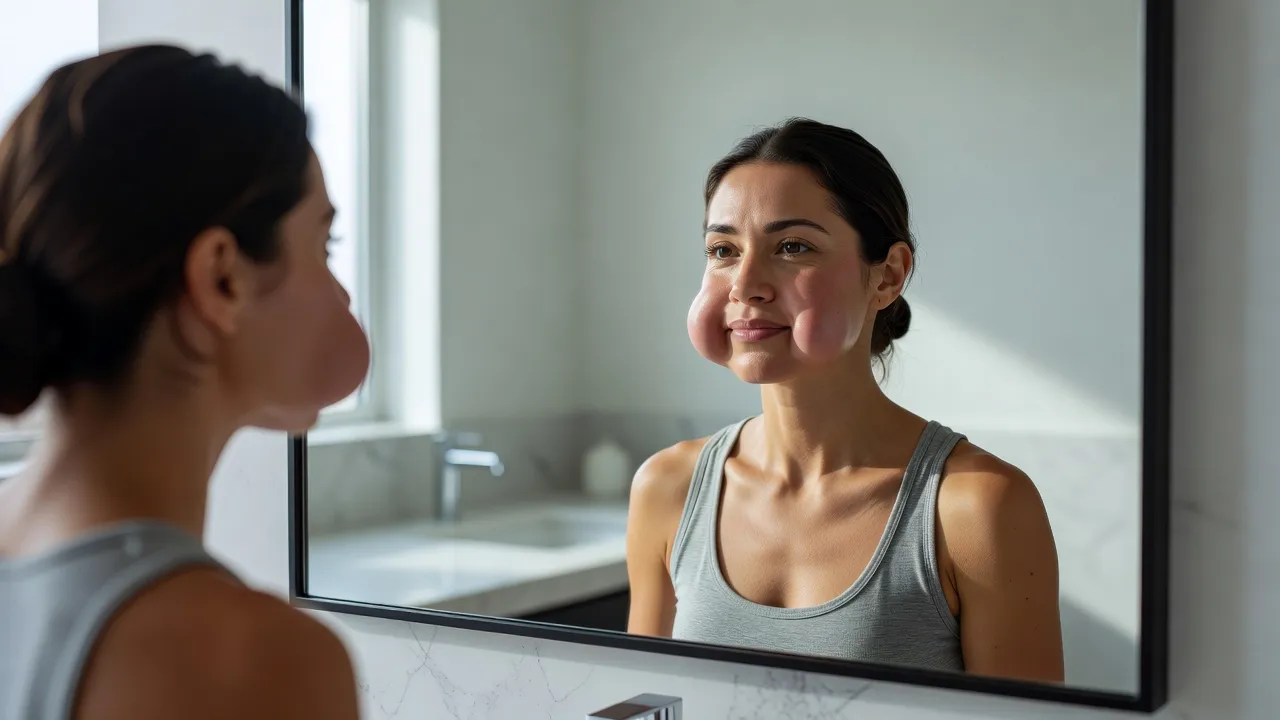
The 2018 JAMA Dermatology study found that a 20-week daily regimen of facial exercises significantly increased upper and lower cheek fullness, visibly reshaping the mid-face area. Led by researchers at Northwestern University, the clinical trial observed middle-aged women who practiced 30 specific facial exercises for 30 minutes daily for eight weeks, followed by alternate-day sessions.
According to the official study published in JAMA Dermatology, dermatologists using standardized photographic scales rated cheek fullness as significantly improved after the program. The average rated age of participants decreased from 50.8 years to 48.1 years by the end of the trial.
The findings confirmed that facial muscle growth directly alters external facial volume and contours. By expanding the volume of underlying muscle bellies, facial exercises create a firmer foundation that evens out visual asymmetry across the cheeks and mid-face.
Does face yoga have clinical trial evidence for improving facial symmetry?
Clinical trial evidence specifically evaluating face yoga for facial symmetry is limited, though existing trials confirm localized muscle hypertrophy after targeted training. Most peer-reviewed studies focus on general volume restoration and facial rejuvenation rather than bilateral symmetry measurements.
While face yoga incorporates isometric holds similar to physical therapy, trials rarely isolate left-to-right symmetry as a primary endpoint. Most data supporting symmetry improvements come from neurological rehabilitation literature rather than commercial face yoga programs.
For those attempting to learn how to achieve face symmetry, face yoga routines work best when customized. Standardized routines that exercise both sides of the face equally often perpetuate existing muscle imbalances instead of correcting them.
Do facial exercises help facial asymmetry from Bell's palsy or paralysis?
Yes, targeted facial re-education exercises significantly improve facial symmetry in patients recovering from Bell's palsy and facial nerve paralysis. Neuromuscular re-education uses tailored exercises to retrain damaged nerves and restore coordinated movement between symmetrical facial muscles.
Physical therapists design these exercises to suppress synkinesis (involuntary muscle movement) while strengthening weak facial muscles on the affected side. Controlled movements focus on isolated eye closures, lip corners, and cheek lifts to ensure both sides move in unison.
Randomized trials confirm that early physical therapy intervention accelerates symmetrical recovery compared to passive waiting. Patients who perform guided biofeedback exercises achieve significantly better resting lip and eye alignment.
What is the American Academy of Dermatology's position on facial exercises?
The American Academy of Dermatology notes that while facial exercises might tone underlying muscles, excessive repetitive facial movements can potentially deepen expression wrinkles. The skin loses elasticity as it ages, meaning constant folding during intense facial contortions may cause dynamic lines to become permanent static wrinkles.
In guidance published by the American Academy of Dermatology, dermatologists emphasize that while underlying muscles may expand, skin folds during exaggerated expressions can accelerate skin aging.
Because of this risk, dermatologists recommend gentle isometric holds rather than aggressive facial contortions. Controlling movements minimizes heavy skin folding while providing the mechanical strain required for muscle conditioning.
Is there an association between facial exercises and facial muscle hypertrophy?
Yes, clinical studies show a clear positive association between resistance facial exercises and facial muscle hypertrophy, particularly in the zygomaticus and masseter muscles. Like skeletal muscles in the body, facial muscles undergo hypertrophy when subjected to progressive mechanical overload over 8 to 12 weeks.
Ultrasound measurements taken before and after facial exercise programs demonstrate measurable increases in muscle cross-sectional area. The zygomaticus major (which pulls the mouth corners upward) and the masseter (the main jaw muscle) exhibit the highest capacity for size increase.
This muscular expansion helps fill out hollow areas and balanced out uneven sides of the face. strengthening a weaker zygomaticus muscle lifts a sagging cheek corner, directly improving resting facial symmetry.
Facial Symmetry Exercises: Step-by-Step Routine
The following six-step routine focuses on single-sided isolation to correct muscle imbalances. Perform these steps once daily, spending extra effort on your weaker side.
- Step 1: Dominant Side Check
- Step 2: Single-Cheek Lifter
- Step 3: Lip Squeezes & Holds
- Step 4: Jawline & Temporalis
- Step 5: Eye & Brow Alignment
- Step 6: Habitual Posture Reset
Step 1: Identify your dominant and non-dominant facial side
Begin by analyzing your facial expression in a neutral camera shot to determine which side exhibits weaker muscle tone. Look closely at the height of your eyebrow arches, the lift at the corners of your mouth, and the depth of your nasolabial folds.
You can also complete a digital analysis of face to isolate minor muscular drop or volume loss that might not be obvious in a standard mirror.
Once you identify the weaker side, plan to perform 50% more repetitions on that side during your exercise sessions. Balancing your muscle strength requires extra stimulation on the lagging side.
Step 2: Perform the single-sided cheek lifter
Isolate the zygomaticus muscle on your weaker side by pulling that cheek upward while keeping the opposite side completely relaxed. Place your index finger lightly on the upper cheekbone of your stronger side to hold the muscle still.
- Smile strictly using the corner of your mouth on the weaker side.
- Hold the contraction at the peak for 5 seconds.
- Slowly release back to a neutral resting position over 3 seconds.
- Repeat for 15 repetitions on the weaker side, compared to 10 repetitions on the stronger side.
This exercise lifts lower cheek tissue and evens out mid-face height.
Step 3: Practice asymmetrical lip squeezes and smile holds
Correct uneven lip corners by applying manual resistance to the stronger side while actively flexing the weaker corner of your mouth. Press two fingers against the lip corner of your stronger side to block its movement completely.
Pucker your lips slightly and slide the mouth corner of your weaker side outward and upward as if smiling half-way. Hold this position for 6 seconds before relaxing.
Complete 12 focused repetitions. This single-sided movement trains the orbicularis oris and risorius muscles, providing better resting mouth symmetry.
Step 4: Execute targeted jaw line resets and temporalis releases
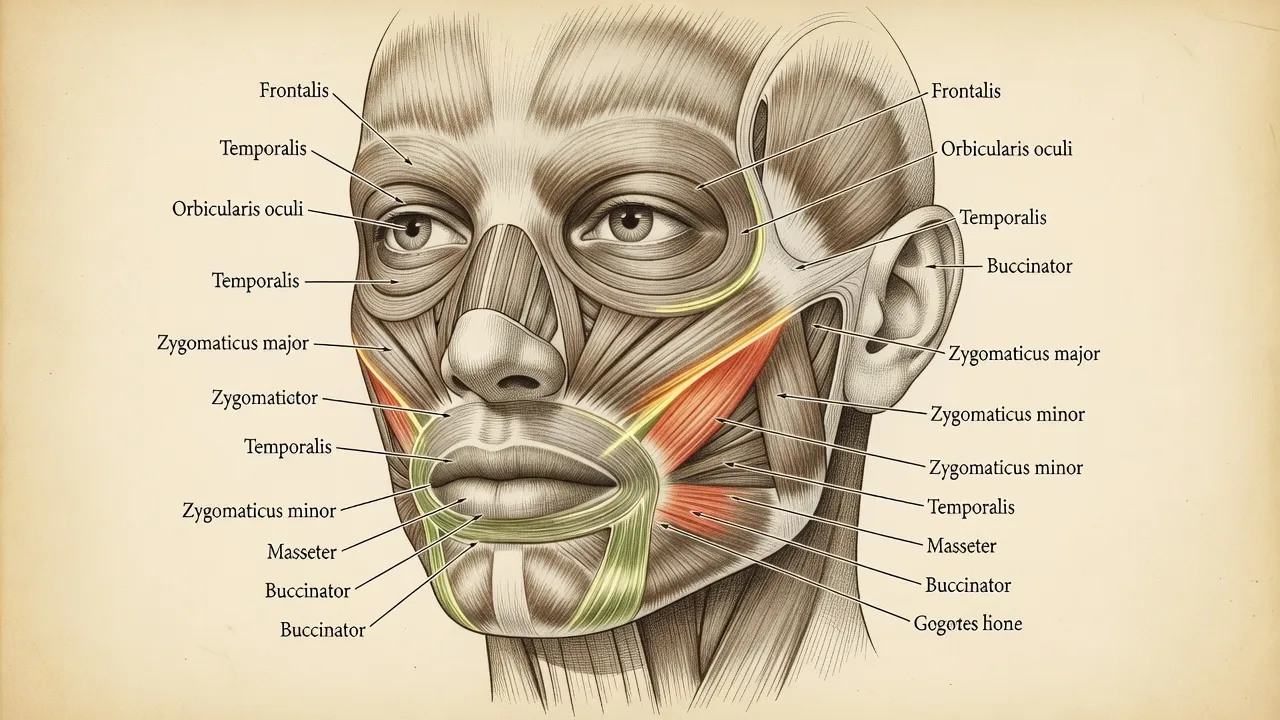
Balance masseter muscle tension by releasing the overworked chewing muscle while strengthening the weaker side. Uneven masseter size is one of the most common causes of lower-face asymmetry.
- Place the palm of your hand against the lower jaw on your stronger side to provide gentle resistance.
- Move your lower jaw slightly toward the weaker side against your hand's pressure.
- Hold the strain for 5 seconds, then relax.
- Massage the masseter muscle on your dominant chewing side for 60 seconds to release chronic tension.
Addressing uneven jaw tension helps clarify how to make face symmetry noticeable across your jawline.
Step 5: Execute eye and brow alignment squeezes
Lift a drooping eyebrow or lower eyelid by performing isolated eyebrow raises and eyelid holds. Eyebrow height differences alter overall facial balance significantly.
Place three fingers directly over the eyebrow on your higher, stronger side to anchor it in place. Lift the eyebrow on your weaker side against gravity using only its forehead muscle (frontalis).
Hold the eyebrow at its highest point for 4 seconds, then lower it slowly. Perform 15 repetitions daily to lift the drooping brow line.
Step 6: Fix daily habitual strain and face posture
Prevent daily habits from undoing your exercise progress by maintaining proper oral posture and sleep position. Continually sleeping on one side flattens cheek tissue and creates asymmetry over time.
Maintain correct rest tongue position by pressing your entire tongue against the roof of your mouth while resting. Keep your teeth slightly apart and lips gently closed.
If you struggle with jaw clenching or asymmetrical resting position, reviewing proper face posture principles ensures long-term alignment retention.
Exercise Summary & Routine Schedule
| Step | Exercise Name | Daily Time | Targeted Muscle / Area | Primary Benefit |
|---|---|---|---|---|
| Step 1 | Dominant Side Identification | 2 Minutes | Full Facial Structure | Sets target reps for baseline correction |
| Step 2 | Single-Sided Cheek Lifter | 3 Minutes | Zygomaticus Major | Raises sagging cheek tissue |
| Step 3 | Asymmetrical Lip Squeezes | 3 Minutes | Orbicularis Oris & Risorius | Evens out mouth corner height |
| Step 4 | Jawline Reset & Release | 4 Minutes | Masseter & Temporalis | Rebalances chewing tension & jaw width |
| Step 5 | Eye & Brow Alignment | 3 Minutes | Frontalis & Orbicularis Oculi | Corrects uneven eyebrow height |
| Step 6 | Habitual Posture Reset | Continuous | Oropharyngeal Musculature | Prevents mechanical compression |
How to fix face symmetry and track your progress over time
Tracking visual changes requires consistent lighting, fixed camera distances, and objective face measurement tools. Because facial muscle hypertrophy develops gradually over 8 to 12 weeks, daily mirror checks often fail to show minor structural improvements.
Taking standardized weekly photos allows you to measure changes in cheek height, lip corner angles, and eye symmetry over time.
For an objective, automated baseline, you can use the Glow Up & Attractiveness Test app. By snapping a selfie, you receive a detailed face analysis from a fine-tuned AI model along with a personalized face rating score.
Using the built-in beauty score breakdown and personalized tips allows you to track your symmetry progress week after week. If you want to know how to improve face symmetry effectively, combining single-sided muscle isolation with digital tracking ensures your efforts deliver results.
- Snap Baseline Selfie (Glow Up & Attractiveness Test App)
- Perform 6-Step Single-Sided Isolation Routine (Daily)
- Retest Symmetry Score via AI Analysis (Every 4 Weeks)
These steps occur in sequence, with step 2 performed daily after step 1, and step 3 performed every 4 weeks following step 2.
Frequently Asked Questions
How long does it take for face exercises to fix symmetry?
Muscular changes typically require 8 to 12 weeks of daily practice before becoming visually noticeable. Results depend on whether the asymmetry stems from soft tissue imbalance or skeletal bone structure.
Can face exercises fix a jawline that looks uneven?
Face exercises can strengthen an underused masseter muscle to balance jaw thickness across both sides. However, exercises cannot shift the physical bone position if your jaw bone is crooked or misaligned.
Should I exercise both sides of my face equally for symmetry?
No, exercising both sides equally maintains existing muscle imbalances. You should perform extra repetitions and targeted holds on the weaker or less developed side of your face.
Can chewing on one side cause facial asymmetry?
Yes, chewing predominantly on one side causes hypertrophy in that masseter muscle, making one side of your jaw look wider or lower than the other.
Do facial exercises cause wrinkles?
Over-contorting the face can crease the skin repeatedly, potentially deepening dynamic expression lines. Performing controlled isometric holds rather than extreme facial expressions minimizes wrinkle risk.
How often should I perform facial symmetry exercises?
You should practice single-sided facial exercises six days per week for 10 to 15 minutes per session to trigger muscle adaptation without straining facial nerve tissue.