
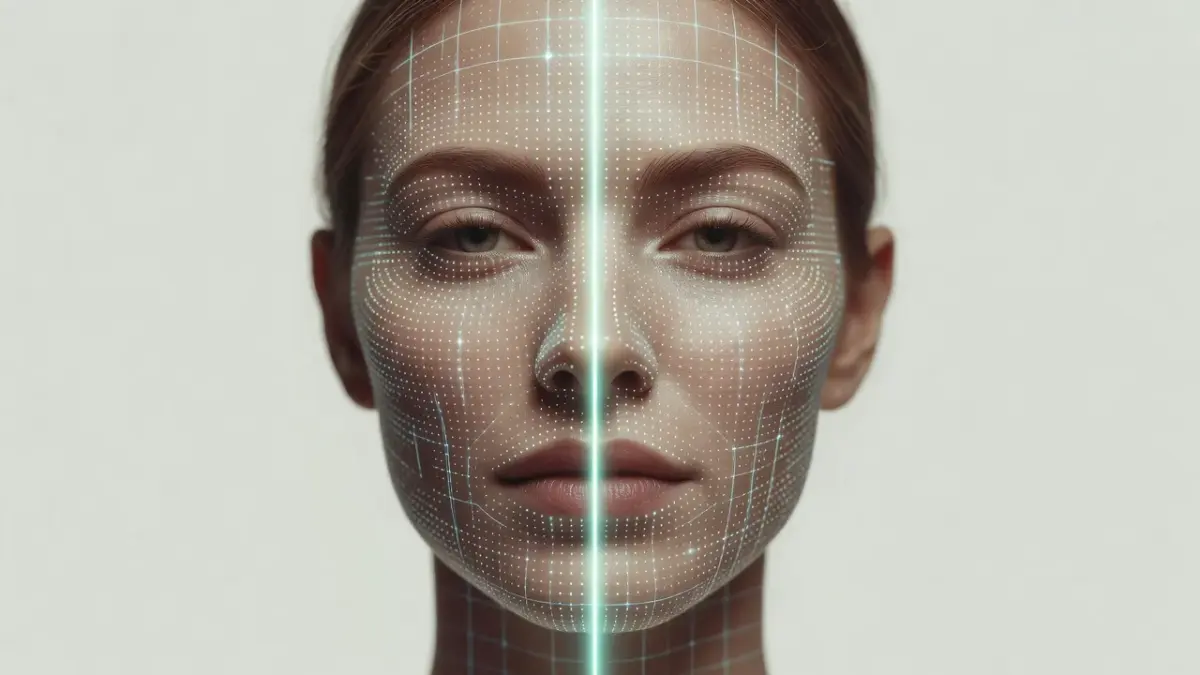
Face symmetry is the structural alignment of facial features where the left and right halves of the face closely mirror each other across a central vertical midline. While perfect bilateral equality does not exist in biological human faces, higher degrees of facial symmetry are strongly linked to human perception of attractiveness, biological health, and developmental stability.
When we evaluate a face, our brains process facial proportions in milliseconds. Tiny variations between the left and right sides occur naturally during human growth. Understanding the mechanics of facial balance helps separate social media myths from structural facial anatomy. For a step-by-step method to measure your own facial ratios, start with careful photo alignment.
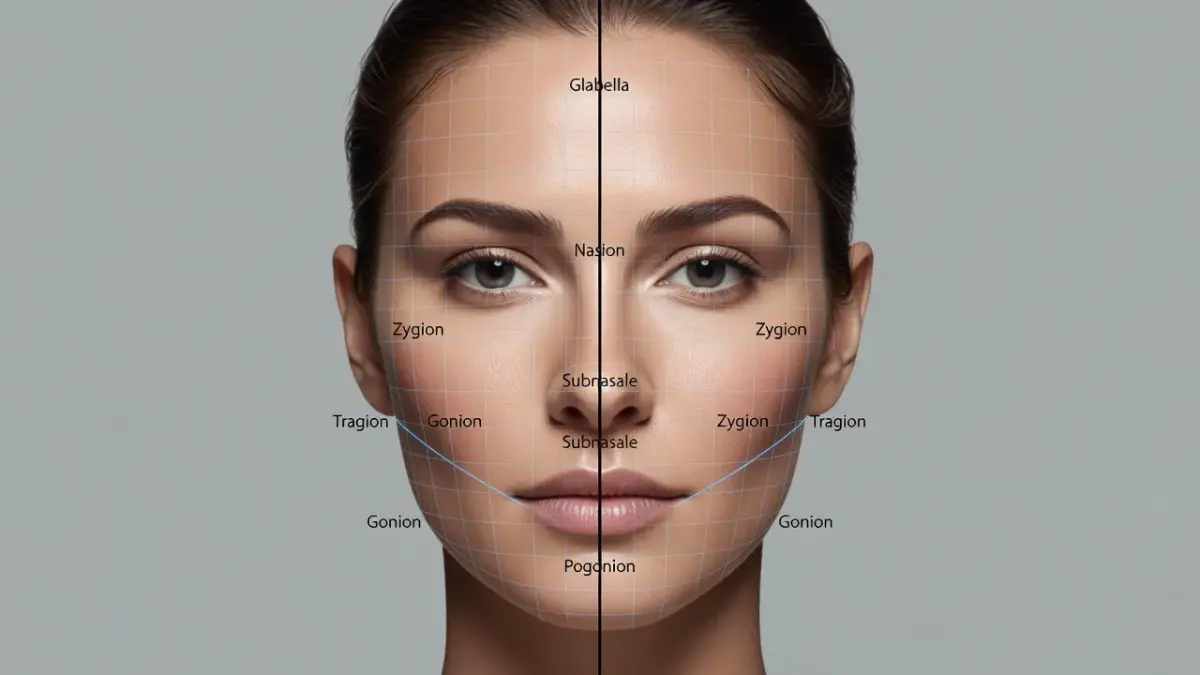
What areas of the face determine symmetry and balance?
The primary areas that determine facial symmetry are the eyes, the nasal bridge, the lips, and the jawline. These central structural points define the horizontal planes and vertical midline of the skull.
If any of these key facial zones sit off-axis, the entire face feels visually unbalanced:
- The Ocular Plane (Eyes): Symmetry here depends on interpupillary distance and whether both eyes sit on an identical horizontal line. Eyelid position and eyebrow arch height also play major roles.
- The Nasal Midline (Nose): The bridge of the nose acts as the primary vertical anchor of the face. Deviation of the septum or a crooked nasal tip breaks the central vertical axis.
- The Labial Complex (Mouth and Lips): Balance is determined by whether the corners of the mouth (cheilions) line up horizontally when the mouth is at rest. The alignment of the upper lip philtrum with the upper central incisors is also critical.
- The Mandibular Frame (Jaw and Chin): The gonial angle on each side of the jaw bone dictates lower face balance. A chin point that deviates to the left or right creates noticeable lower third asymmetry.
When evaluating a face front view, researchers examine how these features align relative to the three equal vertical thirds and five horizontal fifths of human facial proportion.
How is facial symmetry measured using landmark-based Procrustes analysis?
Landmark-based Procrustes analysis measures facial symmetry by mapping specific 2D or 3D coordinate points across the face and mathematically rotating, scaling, and superimposing them onto a mirrored configuration. This quantitative technique strips away overall face size and camera angle so scientists can measure actual shape deviation.
In biometrics and biological anthropology, researchers place anatomical landmarks on defined anatomical sites:
- Endocanthion and Exocanthion: The inner and outer corners of each eye.
- Alare: The widest outer points of the nostril wings.
- Cheilion: The far corners of the lips.
- Zygion: The most prominent outer points of the cheekbones.
Once these points are mapped into X, Y, and Z coordinates, Generalized Procrustes Analysis (GPA) translates and rescales the face. The mathematical difference between the original landmark positions and their reflected positions is calculated as the Procrustes distance. According to landmark research published on PubMed, Procrustes analysis isolates true structural variations from simple positioning errors in photography.
As of October 2026, clinical researchers use 3D surface scanners paired with Procrustes algorithms to plan reconstructive jaw surgeries and evaluate facial paralysis recovery.

How is fluctuating asymmetry in the face measured using geometric morphometrics?
Fluctuating asymmetry in the face is measured using geometric morphometrics by calculating random, non-directional deviations from perfect bilateral symmetry across paired landmark sets. Unlike directional asymmetry (where one side is systematically larger, like the human heart location), fluctuating asymmetry reflects small developmental instability caused by genetic or environmental stress during growth.
Geometric morphometrics breaks facial variation into two distinct statistical components:
- Symmetric Component: The average structural shape of the face after averaging the left and right sides together.
- Asymmetric Component: The individual differences between the left and right sides.
To measure fluctuating asymmetry accurately, software captures multiple landmark configurations from the same face to account for measurement error. The residual variance between the right side and left side landmarks - after removing directional bias - represents the individual's fluctuating asymmetry score.
A study archived on PLOS ONE notes that lower levels of fluctuating asymmetry correlate with higher perceived facial attractiveness because symmetry serves as a subtle indicator of biological health.
How is facial symmetry measured using computer vision reflection symmetry algorithms?
Computer vision reflection symmetry algorithms measure facial symmetry by splitting a digital image along the central vertical axis, flipping one half horizontally, and computing the pixel variance or feature vector distance against the opposite half. Modern artificial intelligence systems automate this process in real time using deep neural networks.
The computer vision pipeline typically follows three steps:
- Facial Alignment and Normalization: The algorithm detects key landmarks (such as the pupils and nose tip) to crop, straighten, and level the image.
- Axis Localization: The code determines the optimal midline axis by searching for the line that minimizes difference between left and right facial feature vectors.
- Difference Scoring: The system compares raw pixel intensities (using Mean Squared Error) or high-level facial embeddings (using cosine similarity) between the real side and the mirrored side.
Consumer applications bring these clinical algorithms directly to smartphones. For example, Glow Up & Attractiveness Test uses fine-tuned AI computer vision models to scan selfie landmarks, calculate facial balance, and generate detailed facial analysis reports. Rather than charging thousands for clinical 3D scans, the Glow Up & Attractiveness Test app provides instant beauty scores and targeted improvement suggestions for $9.99/week.
How to assess symmetry of human face features across different methods
Different tools evaluate facial harmony at varying levels of precision and cost. The table below compares the primary ways facial symmetry is measured in 2026.
| Assessment Method | Measurement Technique | Key Metric Evaluated | Primary Advantage | Real-World Cost |
|---|---|---|---|---|
| Glow Up & Attractiveness Test | Mobile AI landmark detection | Structural symmetry score & feature balance | Instant selfie feedback with custom glow up advice | $9.99/week |
| Manual Mirror Analysis | Visual inspection with line guides | Midline alignment & eye level | Completely free to perform anywhere | $0 (Lacks precision) |
| Clinical Procrustes Analysis | 3D coordinate superimposition | Procrustes distance & structural shape variance | Maximum mathematical accuracy for surgery | $500 - $3,000 per clinical scan |
| Geometric Morphometrics | Statistical landmark shape analysis | Fluctuating vs directional asymmetry ratios | Differentiates environmental stress from genetic traits | Requires specialized academic software |
Visual self-checks give a quick rough impression, but digital landmark mapping eliminates subjective bias. Our symmetry face app comparison shows how the leading AI analyzers differ. Many people who study their face notice subtle jaw shifts or uneven eye heights that are completely invisible to everyday observers.
What causes facial asymmetry in everyday life?
Facial asymmetry is caused by a mix of genetic programming, skeletal growth patterns, dental occlusion, and daily lifestyle habits. While your DNA builds the base structural blueprint of your facial bones, environmental factors constantly shape facial muscle tone and tissue density over time.
The primary contributors to facial imbalance include:
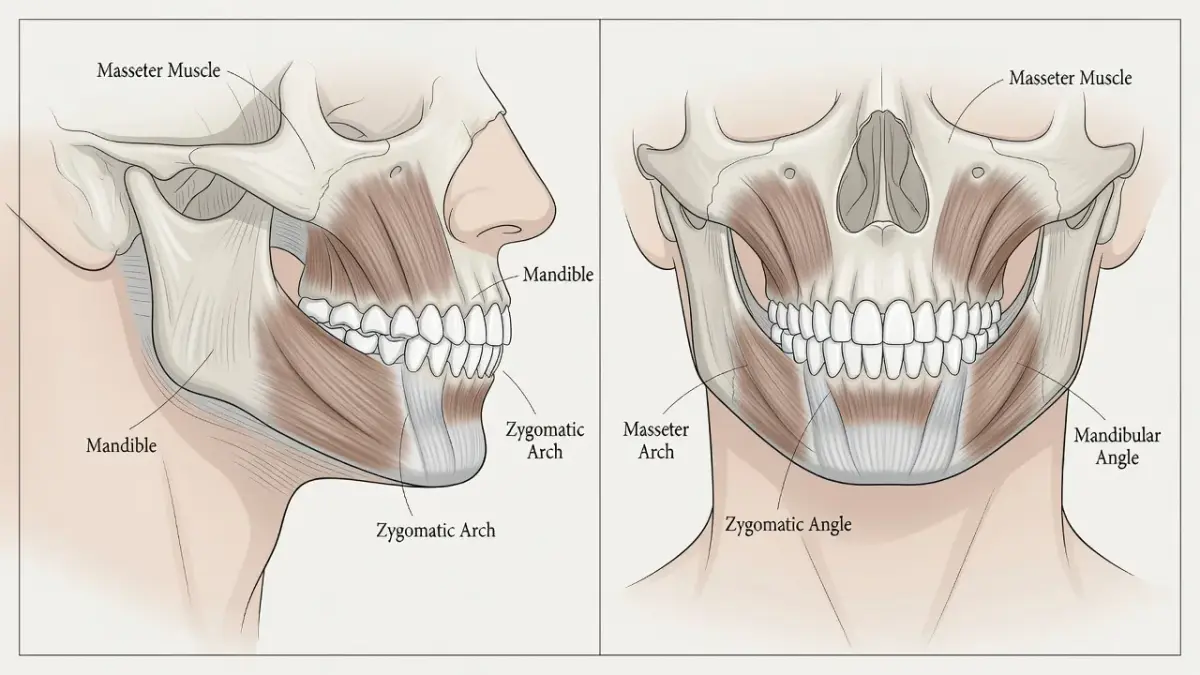
- Chewing Dominance: Habitually chewing food on only one side builds larger masseter muscles on that side, widening one angle of the jaw.
- Sleeping Position: Sleeping face down or consistently on one side places hours of compressive force on facial bones and skin, altering soft tissue volume over years.
- Dental Alignment and Bite: Crossbites, missing molars, or uneven tooth wear force the lower mandible to shift laterally when closing the mouth.
- Natural Aging: As collagen breaks down, skin elasticity drops unevenly across the face, making natural underlying skeletal asymmetries far more visible.
- Postural Habits: Resting your chin on your hand or tilting your head during computer work strains neck muscles (like the sternocleidomastoid), pulling facial alignment off-center.
Understanding these causes is helpful because soft tissue asymmetries can often be managed through targeted habits or targeted face exercises for symmetry.
Does perfect facial symmetry actually make you more attractive?
No, absolute mathematical facial symmetry does not make a person look more attractive; in fact, perfectly mirrored faces often look uncanny and artificial. Research in facial perception consistently shows that subtle asymmetries give human faces character, warmth, and natural realism, a key part of the broader science behind attractive faces.
Psychological studies published on Nature demonstrate that while humans generally prefer faces with high overall balance over extreme asymmetry, perfectly synthesized symmetrical faces rank lower in natural beauty tests than faces with mild, normal variations.
To demonstrate this concept, researchers frequently perform a mirror-image test:
- They take a high-resolution frontal photo of a face.
- They cut the photo down the midline.
- They create two new faces: one made of two left halves, and one made of two right halves.
In almost every case, the left-left and right-right composite photos look surprisingly unfamiliar compared to the original person. Exploring the face symmetry of celebrities reveals that iconic beauty icons like Brad Pitt, Marilyn Monroe, and Zendaya all possess noticeable facial asymmetries, such as slightly uneven eyebrows or a playful crooked smile.
How to improve your overall facial harmony without surgery
Improving facial harmony without surgery relies on balancing soft tissues, optimizing oral posture, and utilizing styling techniques that create visual proportion. While non-surgical methods cannot alter mature bone structures, they significantly enhance how balanced your face appears in daily life.
Here are actionable strategies to enhance your natural facial balance:
1. Correct Your Oral Posture and Chewing Habits
- Mewing / Tongue Posture: Rest your entire tongue flat against the roof of your mouth with your lips sealed and teeth gently touching. This supports the midface structure over time.
- Bilateral Chewing: Make a conscious effort to chew food equally on both sides of your mouth to balance masseter muscle development.
2. Adjust Daily Sleeping and Posture Routines
- Back Sleeping: Switch to sleeping on your back using a supportive pillow to prevent mechanical pressure against your cheekbones and jaw.
- Ergonomic Workstation: Position computer monitors directly at eye level so you do not spend hours with your head tilted to one side.
3. Use Strategic Hairstyling and Makeup
- Hair Parting: A deep side part can mask uneven forehead lines or brow levels, while face-framing layers soften strong jawline differences.
- Contouring: Makeup artist contouring allows you to create optical illusions, adding shadow to a wider masseter or highlighting a lower cheekbone to create visual balance.
4. Track Your Facial Analysis Over Time
Using digital AI tracking helps you see which styling changes genuinely enhance your facial score. The Glow Up & Attractiveness Test app allows women to upload selfies, receive detailed face analysis feedback, and follow customized glow up routines to highlight their best natural features. Checking your progress every few weeks ensures your grooming routines actually improve visual harmony. Women weighing which scoring apps to trust can compare attractiveness tests for women.
Frequently Asked Questions
Is everyone's face asymmetrical?
Yes, every human face has natural structural asymmetries. Subtle differences in bone density, eye height, and muscle development exist on everyone, and complete 100% mirror symmetry does not occur naturally in biological growth.
Can face exercises fix an asymmetrical jaw?
Face exercises can strengthen underused masseter or facial muscles, which helps balance soft tissue volume across your jawline. However, facial exercises cannot alter mature skeletal bones or fix structural jaw misalignment caused by bone growth.
Which side of your face is usually more attractive?
Studies in facial perception often suggest that the left side of the human face is perceived as slightly more expressive and attractive. This phenomenon is known as the left-cheek bias and occurs because the right hemisphere of the brain, which processes emotions, controls the left side of facial expression.
Does sleeping on one side cause facial asymmetry?
Yes, consistently sleeping on the exact same side every night places persistent mechanical pressure on your facial bones and soft tissue. Over years, this habit can lead to subtle volume loss in the cheek and deeper nasolabial folds on the slept-on side.
How can I test my face symmetry at home?
You can test your symmetry by taking a well-lit frontal selfie with a straight camera angle, placing a vertical digital line down the center of your nose, and checking if your eyes, mouth corners, and nostrils align evenly across horizontal grid lines. AI tools like Glow Up & Attractiveness Test automate this mapping instantly.
Why do mirror images look different than photos of my face?
When you look in a mirror, you see a flipped reverse image of yourself that your brain has adapted to over your entire life. Standard photos capture your face as others see it, making your natural asymmetries stand out more to you because you are unaccustomed to the non-flipped orientation.