
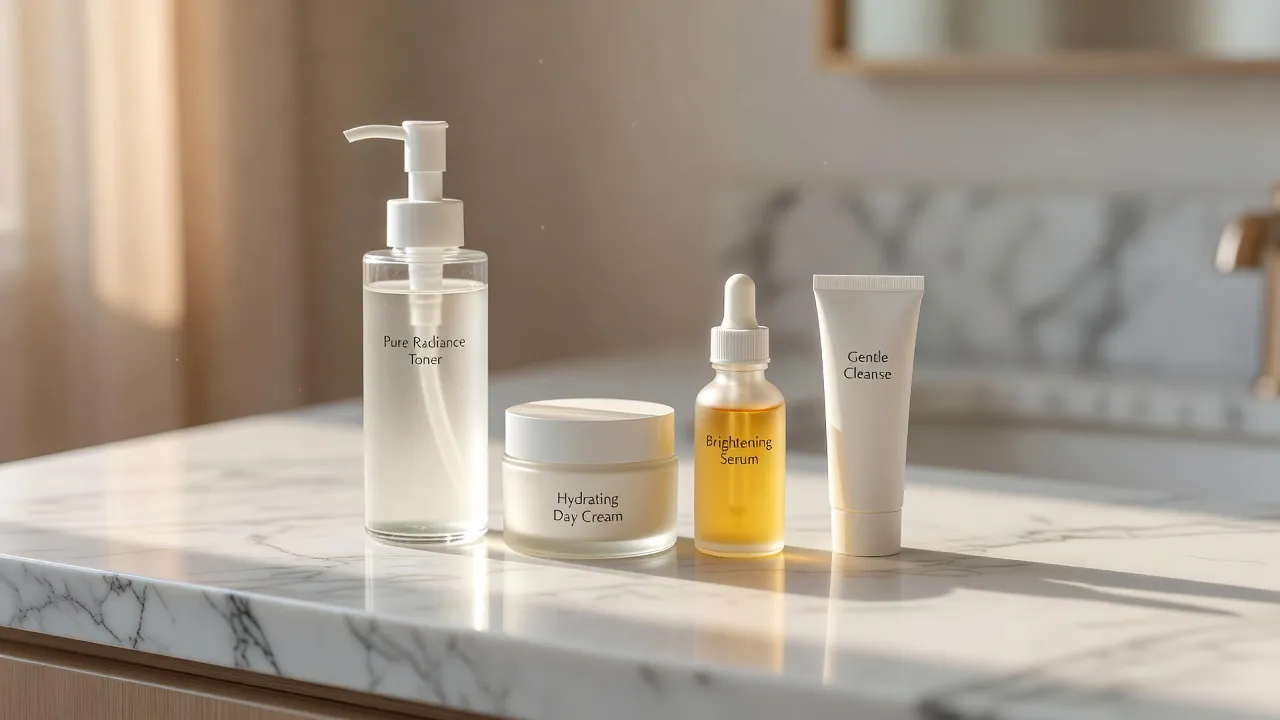
A complete morning skincare routine takes four essential steps - cleanser, vitamin C serum, moisturizer, and sunscreen - and takes less than five minutes each morning. Executing these steps in order of thinnest to thickest consistency protects your skin barrier against daily environmental stress, pollution, and UV damage. Skipping or mixing up this sequence reduces product absorption and leaves your skin vulnerable to premature aging.
Building a solid morning routine does not require a complex ten-step regimen or expensive luxury formulas. Understanding what each product does - and identifying which ingredients match your skin type - helps you construct a streamlined habit that produces noticeable results. If you want to benchmark your baseline skin texture before starting a new regimen, downloading the Glow Up & Attractiveness Test provides a clear starting point.
Where does vitamin C serum fit in the morning skincare routine order?
Vitamin C serum fits directly after cleansing and before moisturizing in your morning skincare routine. Applying it to freshly washed, thoroughly dry skin maximizes penetration, allowing the antioxidant to neutralize free radicals before heavier creams block absorption.
According to clinical research published by the National Center for Biotechnology Information (NCBI), L-ascorbic acid requires a low pH environment below 3.5 to penetrate the stratum corneum efficiently. If you apply moisturizer first, you create an occlusive layer that prevents the active vitamin C from absorbing into the skin.
Wait roughly 60 seconds after applying your serum before moving to moisturizer. This brief pause allows the liquid to settle without getting wiped away by subsequent products.

Should sunscreen be applied before or after moisturizer in a morning skincare routine?
Sunscreen must always be applied after moisturizer as the final step of your morning skincare routine. Chemical and mineral sunscreens need to form an unbroken layer on top of all other skincare products to reflect or absorb UV rays effectively.
The American Academy of Dermatology (AAD) confirms that applying moisturizer over sunscreen dilutes the active SPF ingredients and disrupts the protective film on your face. Even if your moisturizer claims to have sun protection, a dedicated sunscreen applied last provides far more reliable defense.
Allow your moisturizer to absorb for two minutes before placing sunscreen on top. This prevents pilling, which happens when products react and ball up on the skin surface.
Morning Skincare Routine Steps at a Glance
The following table breaks down the entire morning skincare sequence, detailing the time required, primary objective, and core requirements for each step.
| Step Number | Routine Step | Estimated Time | Key Requirement |
|---|---|---|---|
| Step 1 | Gentle Cleanser | 60 seconds | Lukewarm water, sulfate-free formula |
| Step 2 | Antioxidant Serum | 45 seconds | Apply to 100% dry skin |
| Step 3 | Hydrating Moisturizer | 45 seconds | Formula matched to skin type |
| Step 4 | Broad-Spectrum SPF 30+ | 90 seconds | Minimum 1/4 teaspoon for face and neck |
| Step 5 | Target Customization | Optional (30s) | Spot treatment or tinted base if needed |
Step 1: Cleanse with a gentle, non-stripping cleanser
Start your morning by washing your face with a mild, water-based cleanser to remove sweat and overnight oil build-up. You do not need harsh scrubs or deep-pore clarifying washes in the morning because your skin has not been exposed to outdoor dirt or makeup overnight.
- Splash your face with lukewarm water rather than hot water, which strips natural lipids.
- Massage a nickel-sized amount of cleanser into your skin using circular upward motions for 30 seconds.
- Rinse thoroughly and pat - do not rub - your face dry with a clean microfiber towel.
If you have extremely dry or sensitive skin, washing with plain water in the morning is often enough. Save your active cleanser for your skincare routine at night when you need to melt away sunscreen and environmental pollutants.
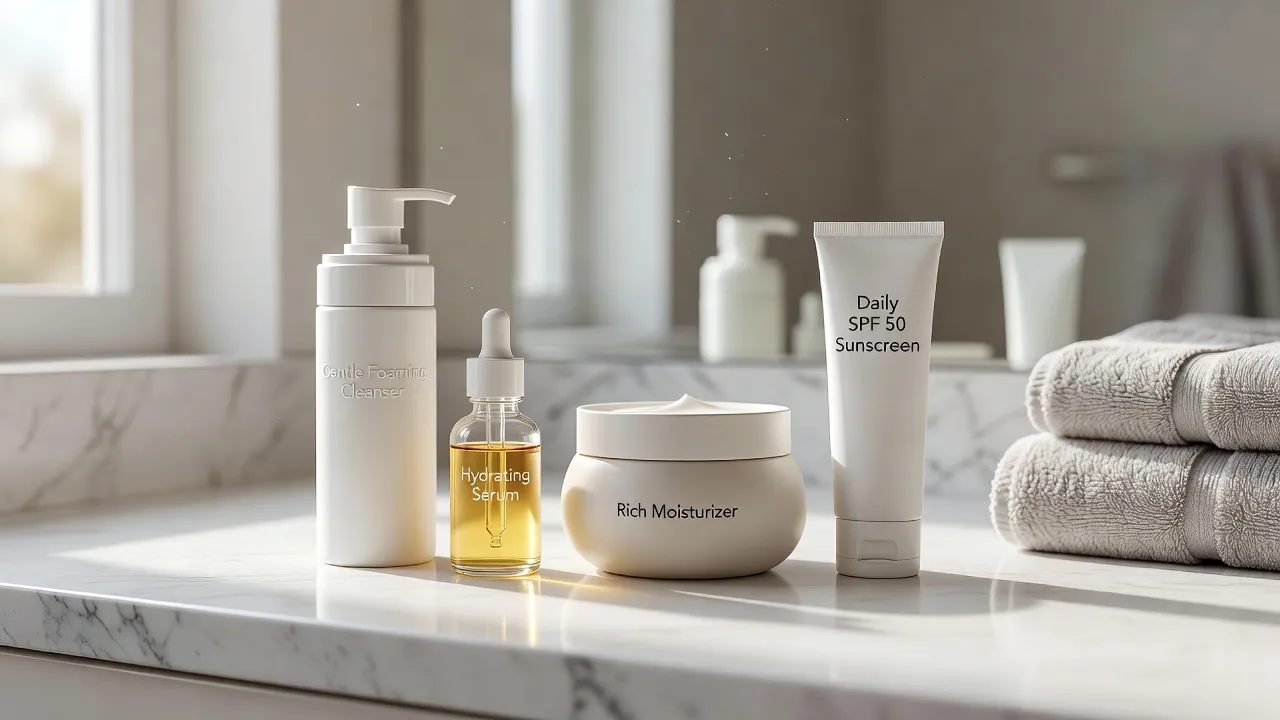
Step 2: Apply an antioxidant serum to clean, dry skin
Apply 3 to 5 drops of an antioxidant serum - such as vitamin C, niacinamide, or ferulic acid - immediately after drying your face. Antioxidants shield your dermal cells from oxidative stress caused by atmospheric pollution and blue light exposure throughout the day.
- Squeeze the dropper directly onto your fingers rather than touching the applicator tip to your skin to prevent bacterial contamination.
- Press the product gently into your face and neck area rather than aggressively rubbing it in.
- Give the serum 45 to 60 seconds to absorb completely before touching your face again.
If you experience tingling or redness from L-ascorbic acid, swap it for sodium ascorbyl phosphate or a 5% niacinamide formulation. These gentler derivatives deliver brightening benefits without irritating sensitive skin barriers.
Step 3: Layer on a lightweight hydrating moisturizer
Apply a quarter-sized amount of moisturizer across your face and neck to lock in hydration and support your moisture barrier. Skipping moisturizer because your skin feels oily actually backfires; dehydrated skin overproduces sebum to compensate for missing surface moisture.
- Choose a gel-cream formula if you have oily skin, or a richer cream containing ceramides if you have dry skin.
- Distribute the product evenly across your forehead, cheeks, nose, and chin before smoothing it outward.
- Do not forget your neck and chest area, as these spots show early signs of sun damage and aging just as quickly as your face.
Look for formulas rich in hyaluronic acid, glycerin, or squalane. These humectants pull moisture into the outer skin layer and maintain a smooth, plump surface throughout the workday.
Step 4: Protect with broad-spectrum SPF 30 or higher sunscreen
Apply a broad-spectrum sunscreen with an SPF rating of at least 30 as your non-negotiable final step. Sunscreen is the single most effective product for preventing premature wrinkles, hyperpigmentation, and skin damage.
The Skin Cancer Foundation (Skin Cancer Foundation) notes that broad-spectrum SPF 30 filters out roughly 97 percent of incoming UVB rays. To get the full protection advertised on the bottle, you must use a full two-finger length (or 1/4 teaspoon) of sunscreen for your face alone.
- Blend the product thoroughly along your hairline, jawline, and behind your ears.
- Reapply every two hours if you are working near bright windows or spending time outdoors.
- If you wear cosmetics, let your sunscreen sit for three minutes before applying foundation to avoid disrupting the protective film.
Step 5: Customize targeted treatments for your specific skin type
Incorporate optional targeted treatments only after your basic four steps are locked in place. Adding extra layers without understanding your skin limits leads to clogged pores, redness, and product pilling.
If you struggle with dullness or uneven tone during a 6 week glow up, you can adjust your morning steps to fit your exact needs.
- For oily or acne-prone skin: Swap heavy creams for an oil-free gel moisturizer containing salicylic acid or zinc.
- For dry or flaky skin: Layer a hydrating facial mist before your serum and choose a ceramide-rich cream base.
- For hyperpigmentation: Look for serums combining vitamin C with alpha arbutin or tranexamic acid.
Keep customization minimal in the morning. Heavy exfoliating acids (like glycolic or lactic acid) and retinoids belong exclusively in your nighttime routine because they increase sun sensitivity.
How to adjust your morning skincare routine for oily, dry, or sensitive skin
Your specific skin type dictates which product textures you should use, but the fundamental four-step order remains unchanged. Understanding your skin's threshold prevents product overload and barrier breakdown.
Oily skin requirements and limits
Oily skin types often struggle with heavy layering. If your T-zone turns shiny by noon, limit your morning routine to three items by using a hydrating sunscreen that doubles as your daily moisturizer. Avoid heavy plant oils (like coconut or wheat germ oil) and opt for water-based fluid gels containing niacinamide to regulate sebum production.
Dry skin requirements and limits
Dry skin needs occlusive ingredients to prevent transepidermal water-loss. If your skin feels tight or looks like ashy skin, skip morning cleansing with soap entirely and wash with cool water. Layer a rich moisturizer packed with fatty acids over damp skin before sealing everything with a hydrating mineral sunscreen.
Sensitive skin requirements and limits
Sensitive skin reacts quickly to active ingredients and synthetic fragrances. Limit your morning serum to soothing formulations containing centella asiatica, panthenol, or green tea extract. Avoid high-concentration L-ascorbic acid (above 10%) and choose physical sunscreens containing zinc oxide, which sit on top of the skin rather than absorbing into sensitive dermal layers.
Common morning skincare mistakes that ruin your skin barrier
The most frequent mistake in a morning skincare routine is rushing through steps without letting products absorb. Stacking products instantly creates friction, causing ingredients to roll off in small rubbery bits instead of sinking into your skin.
Another widespread error is mixing incompatible active ingredients. Combining vitamin C with benzoyl peroxide or strong AHA/BHA exfoliants in the morning neutralizes the benefits and causes instant irritation and flushing.
Here are four rules to keep your skin barrier intact:
- Never apply sunscreen to damp skin: Moisture compromises the film-forming agents in SPF formulas, leaving patchy gaps in your sun protection.
- Do not skip sunscreen on cloudy days: Up to 80 percent of UV rays penetrate cloud cover and glass windows, damaging skin indoors.
- Avoid touching dropper tips to your skin: Transferring facial bacteria back into your serum bottles spoils your active formulas prematurely.
- Stop over-cleansing: Washing your face with harsh sulfates in the morning strips away natural protective oils created overnight.

Tracking your morning skincare progress with AI face analysis
Maintaining consistency with your morning skincare routine requires tracking changes in your skin texture, tone, and overall clarity over time. Subtle improvements in hydration and radiance can be hard to spot in the mirror day to day.
Using specialized tools can give you objective feedback on whether your new morning products are working. The Glow Up & Attractiveness Test app allows you to take selfies, receive a detailed face analysis from a fine-tuned AI model, and get tailored tips to beautify your look over time.
By taking weekly photos under identical morning lighting, you can track how hydration levels impact your skin's appearance. Seeing your beauty score improve provides clear validation that your morning steps are yielding real results. If you are exploring broader ways on how to look better as a woman, combining a targeted skincare routine with AI analysis gives you a data-driven path to visible glow up success.
Frequently Asked Questions
Can I skip cleanser in the morning and just use water?
Yes, washing your face with plain lukewarm water in the morning is completely fine, especially if you have dry or sensitive skin. Water effectively removes overnight perspiration without stripping the essential natural oils your skin barrier produced while you slept.
How long should I wait between applying skincare steps?
You should wait roughly 30 to 60 seconds between applying serums and moisturizers to let each layer absorb. When applying sunscreen after your moisturizer, wait two full minutes so your moisturizer can settle without disrupting the protective UV layer.
Is vitamin C necessary in a morning skincare routine?
Vitamin C is not mandatory, but dermatologists highly recommend it for morning use. It functions as an antioxidant shield that neutralizes free radicals caused by pollution and UV light, making your daily sunscreen even more effective.
Can I mix my sunscreen into my moisturizer to save time?
No, you should never mix sunscreen directly into your moisturizer or foundation before application. Mixing dilutes the active SPF filters, destroys the formulation's stabilizing agents, and results in uneven, patchy sun protection across your face.
What should I do if my skincare products start pilling?
Pilling happens when products sit on top of the skin instead of absorbing, often caused by mixing oil-based and water-based products or applying layers too quickly. To fix this, exfoliate gently twice a week, apply thinner layers, and wait 60 seconds between steps.
Should I use hyaluronic acid in the morning?
Yes, hyaluronic acid works exceptionally well in the morning routine to plump and hydrate the skin. Always apply hyaluronic acid serum to damp skin right after cleansing, then lock it in immediately with your daily moisturizer.
Do I need to wear sunscreen indoors if I work near a window?
Yes, standard window glass blocks UVB rays but allows UVA rays - which cause skin aging, fine lines, and hyperpigmentation - to pass through easily. Wearing broad-spectrum SPF 30 every morning protects your skin during indoor screen and office hours.