
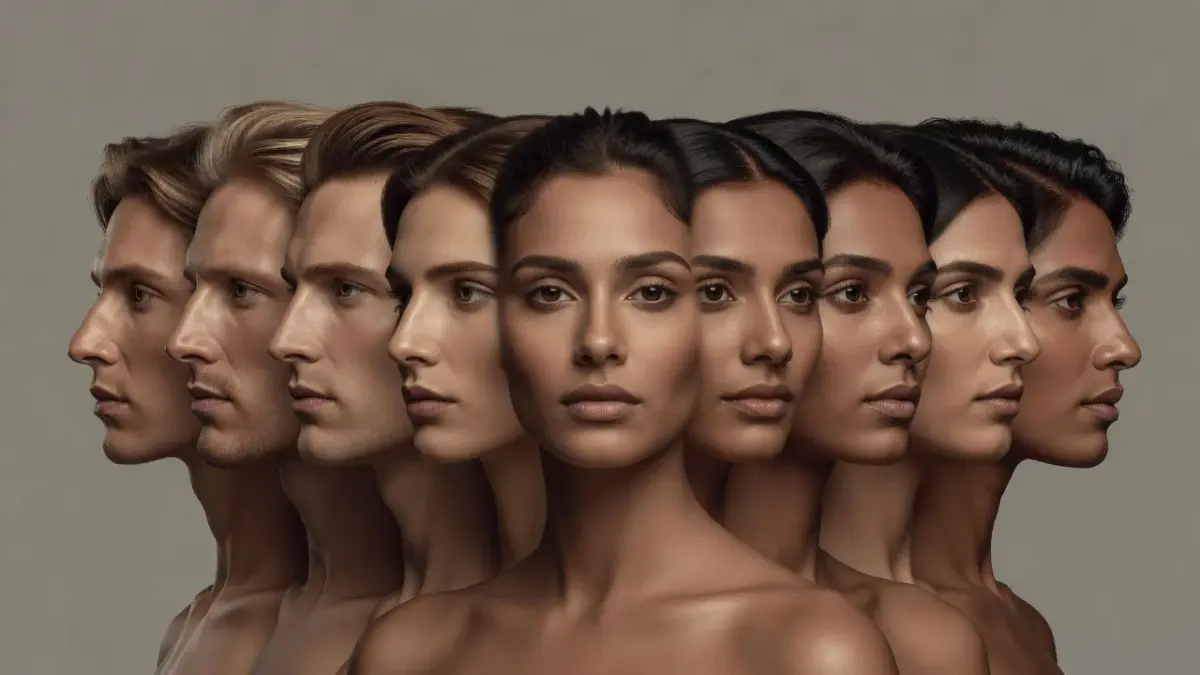
Romani facial features do not conform to a single uniform phenotype, but rather reflect a complex genetic blend originating from northwestern India mixed with centuries of gene flow across Western Asia and Europe. What most people get wrong is treating the Romani people as a racially homogenous group with static physical traits. In reality, over a millennium of migration, founder effects, and regional intermarriage across distinct European sub-groups has created immense diversity in skin tone, eye color, and facial bone structure.
If you are trying to understand your own unique facial structure rather than relying on historical ethnic stereotypes, tools like the Glow Up & Attractiveness Test iPhone app provide an objective breakdown of your personal facial geometry. Using AI analysis, it evaluates proportions like symmetry and midface ratio independently of demographic generalizations.

Do Romani people have distinctive facial features according to anthropology?
Physical anthropology historical classifications failed to identify any universal Romani facial feature because the population exhibits high phenotypic variation across different geographic regions. Early 19th- and 20th-century physical anthropologists frequently tried to categorize Roma populations using rigid cephalic indexes and skin color charts. However, modern biological anthropology rejects these fixed racial classifications, recognizing that centuries of isolation in some regions and integration in others produced diverse facial traits across different Romani groups.
Anthropological studies confirm that while some Romani individuals retain ancestral South Asian ancestral traits - such as warm olive skin undertones, dark brown irises, and prominent brow ridges - others exhibit typical regional European traits. For instance, the Sinti of Central Europe often carry facial phenotypes indistinguishable from surrounding Germanic populations, whereas Vlax Romani groups in Southeastern Europe may present distinct facial proportions influenced by Balkan and Anatolian admixture.
| Romani Subgroup | Primary Geographic Historical Hub | Typical Observed Phenotypic Mix |
|---|---|---|
| Vlax Roma | Southeastern Europe / Balkans | Olive tones, prominent dark eyes |
| Sinti | Germany / Central Europe | Fair to olive skin, mixed eye color |
| Iberian Kale | Spain / Portugal | Mediterranean features, dark hair |
| Romanichal | United Kingdom | Light skin tone, varied eye color |
What do genetic studies say about Romani origins in South Asia and Europe?
Genetic studies overwhelmingly show that the ancestral source population of the Romani migrated out of northwestern India approximately 1,500 years ago before undergoing significant European gene flow. Genome-wide analyses reveal that all European Romani groups share a core South Asian genetic founder lineage that bottlenecked during their journey through Persia and Armenia.
As published in a comprehensive genetic survey on the National Center for Biotechnology Information, the Romani founder population expanded rapidly upon reaching the Balkan Peninsula around 900 to 1,000 years ago. During this settlement phase, extensive admixture occurred with local European populations.
- South Asian Ancestry: Typically accounts for 20% to 50% of the individual genome depending on the specific Romani group.
- European Admixture: Comprises the remaining 50% to 80%, largely derived from Balkan, West Eurasian, and regional host populations.
- Genetic Drift: High levels of endogamy within specific clan structures (clans or vitsi) amplified distinct localized physical characteristics.
This dual lineage explains why individual facial characteristics vary so dramatically even within the same family line.

What does Mendizabal's study on the population history of European Romani show?
Isabel Mendizabal’s 2012 landmark genetic study demonstrated that European Romani originated from a single founder event in northwestern India followed by rapid admixture in the Balkans. By analyzing high-density SNP data across 13 European Romani groups, Mendizabal and her team confirmed that the initial ancestral group left India around 500 CE and entered Europe via Anatolia in the 14th century.
The study, published in Current Biology, proved that after entering the Balkans, the Romani split into distinct regional populations. This historical demographic bottleneck, combined with subsequent gene flow from non-Romani Europeans, generated the wide spectrum of physical traits observed today. Mendizabal’s data clearly refuted the older anthropological myth that Romani groups remained entirely genetically isolated throughout their 700-year history in Europe.
Do genetic studies link Roma facial features to a particular phenotype?
No genetic study has identified a unique gene complex that produces a distinct "Roma facial phenotype." Physical traits like nasal bridge shape, eye shape, lip fullness, and facial width are polygenic, meaning they are controlled by hundreds of independent genetic variants spread across the human genome.
Because European Romani groups experienced different levels of intermarriage with non-Romani (Gadje) neighbors over 30 generations, the genetic markers governing facial morphology differ drastically between sub-groups. A study in the European Journal of Human Genetics documented that genes regulating skin pigmentation (such as SLC24A5 and TYR) in Romani samples show variable allele frequencies matching both South Asian and West Eurasian lineages.
For anyone examining how personal facial geometry develops, looking at broader regional patterns offers far more precision than relying on ethnic stereotypes. You can learn more about how human bone structure is categorized in our guide to European facial features.
How AI Face Analysis Helps Map Personal Facial Geometry
Understanding your facial features comes down to measuring your personal structural symmetry, bone definition, and facial ratios rather than trying to fit into vague ethnic templates. In 2026, algorithmic mapping makes it easy to evaluate how your unique features work together.

The Glow Up & Attractiveness Test app simplifies this analysis by evaluating your facial structure directly from a phone camera.
- Selfie Analysis: Snap a photo to get a personalized face rating score based on established aesthetic metrics.
- Fine-Tuned AI Model: Receive a detailed analysis of your cheekbones, jaw alignment, and midface proportions.
- Tailored Improvement Tips: Get actionable grooming, style, and beauty advice tailored to your specific facial geometry.
Rather than guessing how your features measure up, using dedicated tools provides objective feedback on your balance and symmetry. If you want to dive deeper into ratio analysis, check out our tutorial on how to measure face proportions.
How do Romani activists respond to stereotypes about Roma appearance?
Romani activists reject standardized physical descriptions of Roma people, arguing that essentialist stereotypes fuel discrimination and erase the community's diversity. For centuries, European art, literature, and media caricatured Romani individuals as having dark, ominous eyes, hooked noses, and specific hair textures. Activists emphasize that these tropes were historically used to brand Roma populations as foreign or exotic "others."
Modern advocacy organizations, such as the European Roma Rights Centre (ERRC), argue that racial profiling by law enforcement often relies on these physical caricatures. When police or institutions look for a stereotypical "Gypsy look," they systematically marginalize Romani individuals who fit the trope while ignoring the millions of fair-skinned or light-haired Romani people who do not.
The enforcement of rigid visual standards also impacts broad cultural perceptions of beauty. To see how regional media shapes these ideals, explore our analysis of Eurocentric beauty standards.
What have Yaron Matras and Ian Hancock said about Roma appearance stereotypes?
Linguists and Romani scholars Ian Hancock and Yaron Matras argue that appearance-based stereotypes fail to account for the historical reality of Romani social identity. Ian Hancock, a prominent Romani scholar at the University of Texas at Austin, has frequently noted that Romanipen (Romani identity) is defined by shared culture, language, and ancestral heritage, not by physical appearance or biological purity.
Similarly, linguist Yaron Matras, author of I Met Lucky People: The Story of the Romani, has written extensively on how outside observers invented the myth of a uniform "Gypsy physical type." Matras points out that Romani populations have continuously adapted biologically and culturally to host nations across Central, Eastern, and Western Europe over seven centuries.
- Ian Hancock's Focus: Emphasizes that blood-quantum definitions and physical profiling are relics of 19th-century racial pseudoscience.
- Yaron Matras's Focus: Demonstrates that linguistic and social cohesion - rather than facial morphology - defined Romani survival through centuries of displacement.
Both scholars stress that assuming all Romani share identical facial traits ignores historical intermarriage, regional variation, and documented genetic reality.
Frequently Asked Questions
Can you identify a Romani person by their facial features alone?
No, it is impossible to reliably identify a Romani person based solely on facial features. Romani individuals possess diverse phenotypes ranging from fair skin and light eyes to deep olive complexions and dark hair, depending on their specific subgroup and regional lineage.
Why do some Romani people have light hair and eyes?
centuries of gene flow and intermarriage between Romani groups and non-Romani European populations led to the widespread presence of recessive traits, such as blond hair and blue or green eyes, throughout many Roma communities.
What is the primary origin of the Romani population's genetics?
Genomic research confirms that the Romani population originated in northwestern India around 1,500 years ago. Their modern genetic profile is a mix of original South Asian founder DNA and significant European admixture acquired during their migration through the Balkans.
Is the word "Gypsy" considered an accurate term for Romani features?
The term "Gypsy" is an exonym based on the historical misconception that Romani people originated in Egypt. Most activists and scholars prefer the endonym "Romani" or "Roma," as "Gypsy" carries derogatory connotations and is tied to outdated physical stereotypes.
Do all Romani subgroups share the same physical traits?
No, different Romani subgroups - such as the Vlax, Sinti, Romanichal, and Kale - show noticeable phenotypic differences. Regional isolation, founder effects, and local intermarriage created distinct variance between subgroups across Europe.
How does facial analysis software evaluate features without ethnic bias?
Modern facial analysis algorithms measure geometric relationships - such as the distance between eyes, jaw angle, and facial height ratios - rather than relying on subjective ethnic categories or racial classifications.